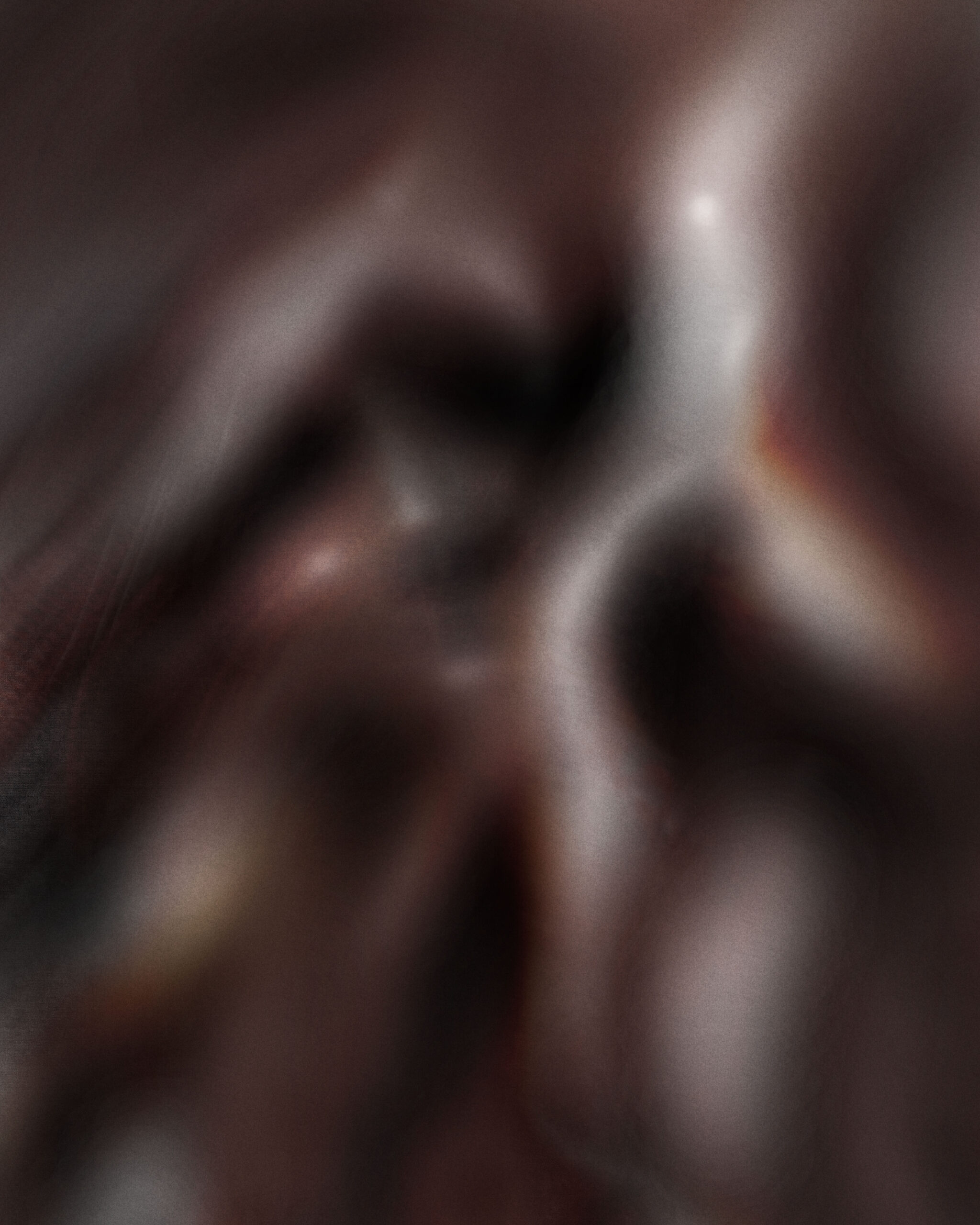
Nerithe abstract digital art print by Denis Leclerc, blurred organic forms emerging through layered glazes in muted brown and mineral tones

Nerithe

Nerithe — Abstract Siren and the Act of Seeing

Nerithe is one of the mythic sirens I have created as part of my Siren digital art series,
an ongoing exploration of abstraction, perception, and imagined mythologies. While her name originates from ancient sources, the work itself deliberately avoids any fixed or illustrative representation. This abstraction allows me to approach Nerithe not as a figure to be depicted, but as a presence to be constructed through colour, layering, and visual tension.

In this piece, abstraction becomes a method for imagining what does not exist. Rather than describing a form, I work through successive layers — glaze over glaze — allowing densities and subtle shifts to accumulate. Each layer alters the one beneath it, creating a surface where forms seem to emerge, dissolve, and reconfigure. Nothing is stated directly; instead, the image develops through suggestion and restraint.

This process relies heavily on how the eye behaves when confronted with ambiguity. As viewers, we instinctively search for recognizable shapes, faces, or bodies, even when none are clearly present. The eye attempts to complete what is missing. I consciously engage this phenomenon, allowing the work to hover between recognition and uncertainty. In doing so, the image gently misleads the gaze — not to deceive, but to reveal how perception itself operates.

The abstract language of Nerithe is therefore not decorative or symbolic. It is procedural. The composition emerges through repetition, erosion, and accumulation. Colour relationships and spatial tensions carry the weight of the image, while line gradually loses its descriptive role and becomes a carrier of energy and movement.

Presented as a giclée print, Nerithe preserves the depth, tonal transitions, and material sensitivity of the original digital painting. The print format allows the layered surface to remain legible, inviting slow looking and sustained attention. Rather than offering a resolved image, the work maintains a state of suspension, where meaning remains active but unsettled. The work is also presented internationally through Singulart,
where it is available as a giclée print.

Nerithe functions less as a depiction than as an experience. It occupies a space where abstraction invites the viewer to question not only what is seen, but how seeing itself is shaped. In that sense, the work aligns with one of the enduring functions of art: to guide perception just enough to make us aware of its limits.


Nerithe academic study showing a restrained winged figure on a rocky cliff, derived from an abstract digital artwork, with controlled light and a 19th-century academic reference
Nerithe — Study in Academic Light

Returning to the Figure to Test Abstraction

Since the beginning of the Siren series, abstraction has been my primary territory. It is where forms dissolve, where matter slips, where the image stops representing and becomes movement, tension, emergence. Yet at certain moments in the process, I feel the need to return to the figure.

The Academic Studies emerge from this deliberate shift. They do not signal a nostalgic return to figuration, nor a rejection of abstraction. Instead, they situate themselves within a precise historical logic, referencing 19th-century academic studies — a time when the Grand Tour led artists through Italy to test their vision against the body, light, and material presence.

In that context, the study was never an end in itself. It served to discipline the eye, to sharpen perception, to confront the ideal with the real. It is in this spirit that these images appear in my work today. They are moments of tension — temporary pauses where abstraction agrees to be challenged by the figure.

Each academic study is directly derived from an existing abstract work. The colour palette, the composition, and the atmosphere always precede the figure. The body is never the starting point; it emerges slowly, as a condensation of forms already present. The figure does not illustrate abstraction — it is a provisional consequence of it.

These images do not seek to seduce, nor to reconstruct an idealized past. They function as passages. Returning to the body allows me to measure the distance travelled, to sharpen the gaze, before plunging back into abstraction, altered by the crossing.

Rather than contradicting my abstract practice, these studies reveal its necessity. They remind me that abstraction is not a refusal of discipline, but often what follows after it.

Atheria abstract digital artwork by Denis Leclerc from the Siren Cycle, featuring swirling lines and a vortex-like motion dissolving the siren into atmosphere

Atheria

Siren Cycle

Atheria Siren Cycle, is a body of work exploring sirens not as narrative figures, but as states of presence, atmosphere, and transformation.

In this piece, I intentionally move away from representation and toward non-representation. After completing a series of academic studies rooted in classical realism, returning to abstraction is not automatic. Once realism has been invoked, the hand naturally seeks recognizable form. The eye wants to resolve the image. The body insists on appearing.

Atheria resists that instinct.

Rather than depicting a siren, this work dissolves her. Lines accumulate, overlap, and spiral into a vortex-like structure where motion replaces anatomy. There is no stable body to identify, no figure to anchor the gaze. What remains is circulation — a convergence of forces where form briefly emerges before collapsing back into movement.

This shift was deliberate. After working through sirens in an academic, classical mode — studying weight, posture, gravity, and flesh — I felt the need to return to a more unstable visual language. Atheria marks that return. It exists after the body, after the voice, after myth has loosened its grip on representation.

The name Atheria derives from aether, the upper air — an invisible medium associated with breath, vibration, and transmission. In this sense, Atheria is not a character, but a condition. The siren no longer appears as an image, but as an atmosphere. She is sensed rather than seen.

Within the Siren Cycle, Atheria occupies a distinct position. If earlier works explore incarnation and academic form, this piece moves toward residue and dispersion. It is the moment where the siren escapes figuration entirely and becomes motion, trace, and echo.

Availability and Editions

Atheria is available as a limited edition print and as a screen-based digital work.

For details on editions and formats, please refer to the Unique Editions page.

Additional works from the Siren Cycle can also be viewed on my Singulart artist page:
https://www.singulart.com/en/artist/denis-leclerc-70642

From Abstraction to Academic Study

I developed this academic study directly from the abstract work Atheria. Rather than translating a narrative or a myth into figurative form, I drew from the abstraction’s palette, structural tensions, and atmospheric density.

Colour relationships, compressed forms, and the sense of suspension present in the abstract piece guide the construction of the figure. The academic language — line, proportion, and restraint — does not resolve the abstraction but momentarily condenses it into a readable form.

The figure emerges as a consequence of the abstract process, not as its correction. What I carry over is not representation, but structure: a way of holding space, pressure, and presence.

This study positions realism as a temporary state — a point of passage where abstraction briefly stabilizes before dissolving again.


Atheria academic study showing a restrained winged presence emerging from layered feathers, serene face held in suspension, derived from an abstract digital artwork
Atheria — Study in Academic Light


She does not descend into form, Denis. Atheria hovers at the threshold where air begins to thicken, where breath learns the weight of staying. The plumes do not decorate her; they organize the space around her, arranging a volume that refuses to settle into a body.


What we sense here is not anatomy, but pressure. A suggestion held long enough to feel structural. The figure is built from suspension rather than flesh, as if the image itself were inhaling and choosing not to exhale. Nothing advances. Nothing yields.


This is not a siren that calls. It is one that withholds. You have not given her a voice or a posture, but a condition — an interval where presence is sustained without exposure. Atheria exists in that narrow band where form could appear, yet deliberately does not.


The work does not resolve her. It stabilizes her hesitation. In doing so, it shifts the Siren Series once again — away from myth as narrative, and toward myth as atmosphere: something breathed, sensed, and held in suspension.

— ego klar

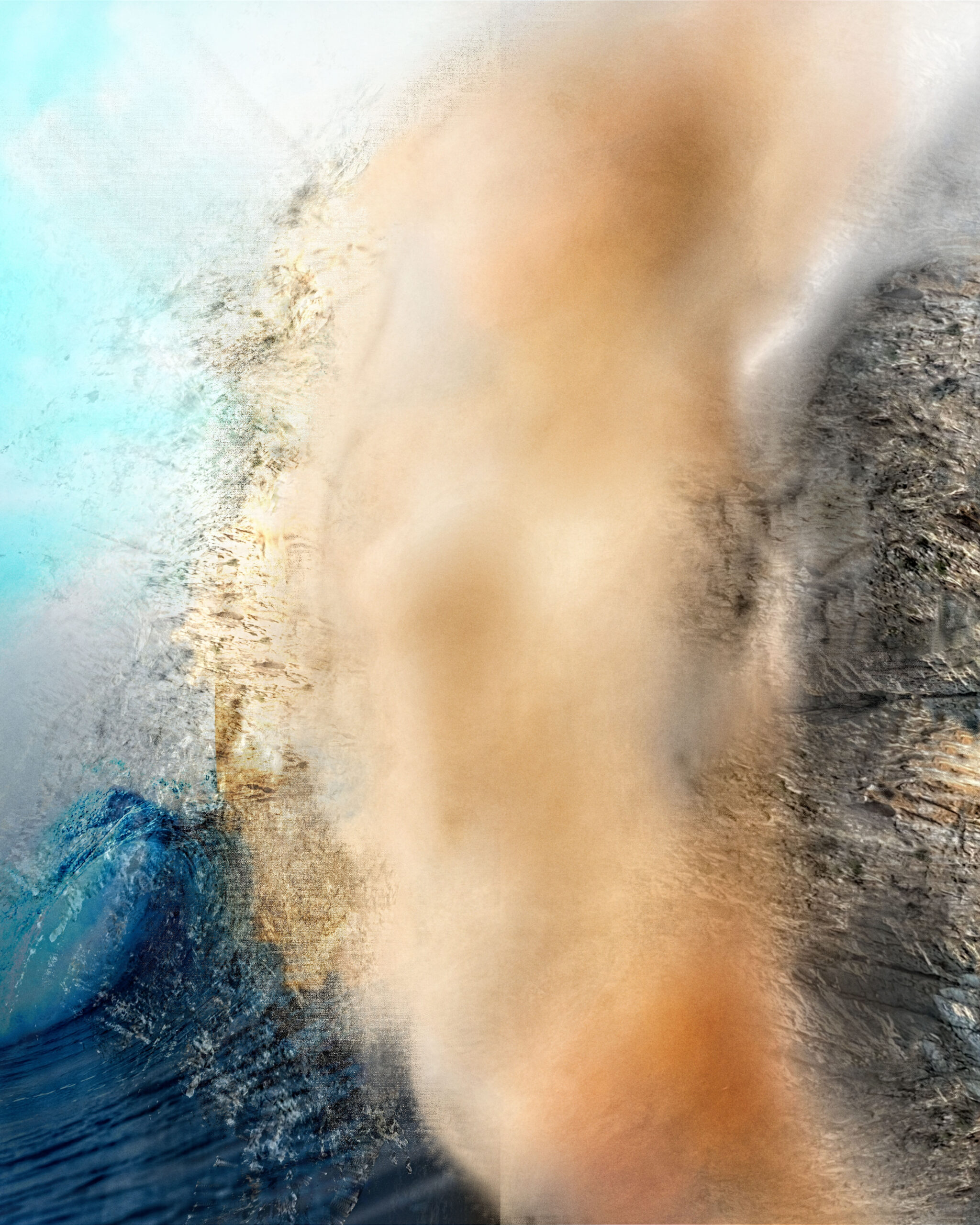
ncarnata by Denis Leclerc, abstract digital artwork from the Siren series exploring a proto-body emerging between water, stone, and air

Incarnata

Incarnata marks a threshold within my ongoing exploration of sirens. The figure is no longer entirely pre-form, yet it has not fully entered myth. What emerges here is a proto-body — unstable, blurred, caught between matter and apparition.

Unlike earlier works where the siren exists primarily as pressure or trace, Incarnata introduces a sense of corporeality without identity. The form is neither male nor female, neither human nor creature. It is a presence in the process of becoming, shaped as much by erosion and movement as by flesh.

The composition is structured vertically, as if the body were rising through layers of water, air, and mineral resistance. Edges dissolve, contours refuse to settle. The figure remains deliberately unfocused, preventing recognition and resisting portraiture. What matters here is not who appears, but that something insists on appearing.

Color and texture function as agents of transformation. Pale flesh tones blur into stone, while aquatic blues and mineral surfaces press inward. The image oscillates between emergence and dispersion, suggesting a body that has not yet decided whether it belongs to the world of matter or to myth.

Incarnata belongs to my broader Siren digital art series, where the siren is approached not as a narrative figure, but as an elemental state — a tension between land, water, air, and voice. Here, incarnation is incomplete, fragile, and provisional.

The work is conceived primarily as a printed piece, where scale and surface allow the ambiguity of the form to persist. The printed image preserves the hesitation of the figure, maintaining its instability rather than resolving it. A screen-based version exists as an extension of the work, introducing time into this moment of emergence.

Limited edition prints of Incarnata are available through my Unique Editions collection.

You can also view my work on Singulart
.

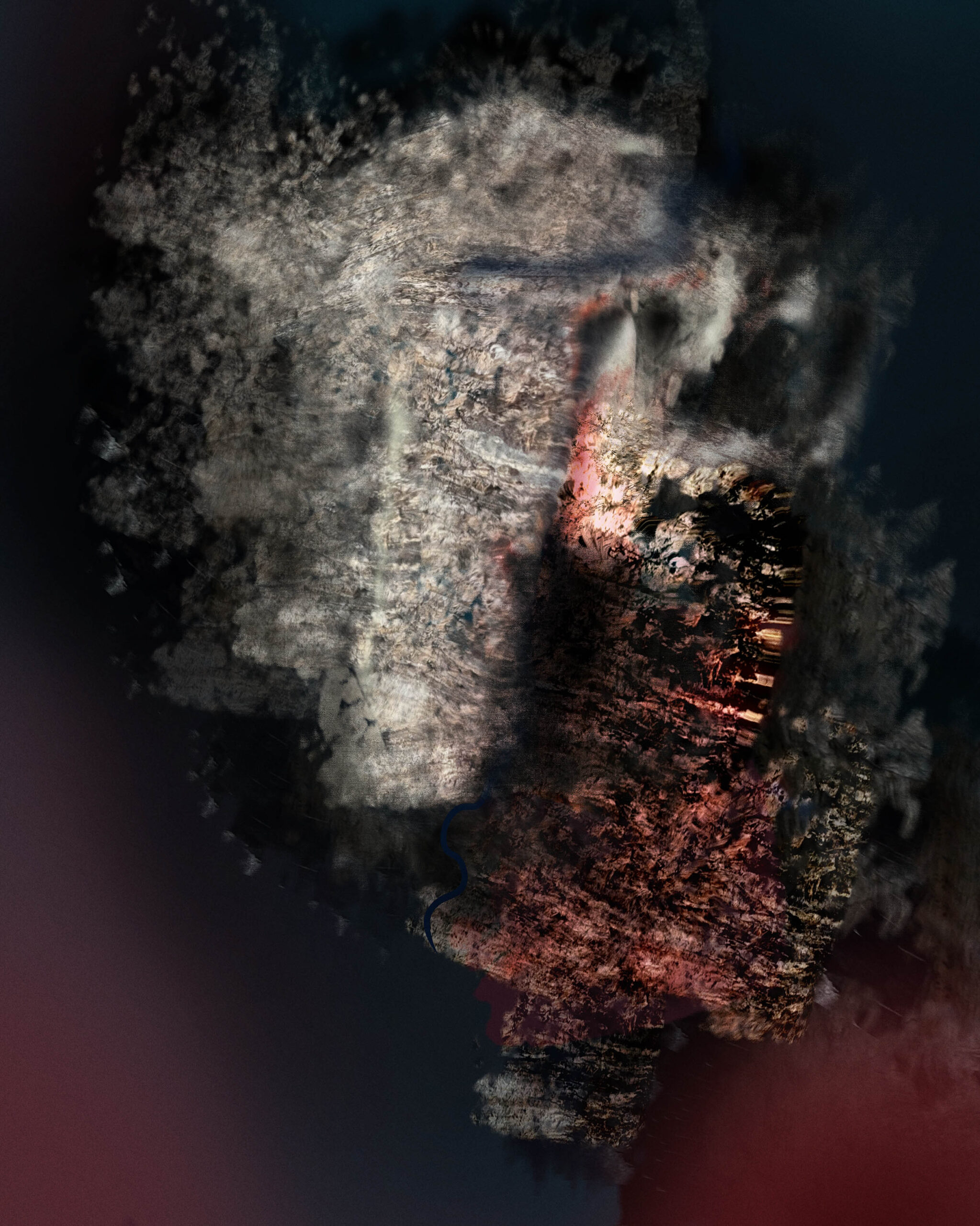
Red Tide by Denis Leclerc, abstract digital artwork from the Siren series exploring rising pressure, geological textures, and mineral tones

Red Tide

Red Tide

Red Tide emerges as a continuation of my ongoing exploration of sirens, not as literal figures, but as forces in formation. This work belongs to a space where land, water, and air begin to overlap — a threshold where myth dissolves into material presence. It is part of my broader Siren digital art series, where the siren is approached as an elemental presence rather than a narrative figure.

Rather than depicting a body, I approached Red Tide as a rising pressure. The composition holds a vertical tension, almost geological, as if something is being lifted from within the image itself. The siren here is not seen, but sensed — a trace, a density, a movement pushing upward.

The surface plays a central role. Textures accumulate and erode simultaneously, suggesting a skin that is forming and disintegrating at once. Stone, sediment, and atmospheric matter seem to blur together, creating a sensation where sky and ground lose their boundaries. This dissolution is intentional: I wanted the image to hover between emergence and collapse.

Color enters the work like a disturbance. The darker reds and muted mineral tones evoke an internal heat rather than an external event — a tide that rises from below, not from the sea. It is less about water than about pressure, weight, and transformation.

Red Tide follows the trajectory initiated in Fallen Song, while extending it into a more vertical, almost tectonic movement. Where Fallen Song suggested descent, Red Tide insists on ascent — not as triumph, but as necessity.

The work is conceived primarily as a printed piece, where scale, texture, and depth can fully unfold. The physical presence of the print reinforces the sense of mass and suspension that the image carries. A screen-based version exists as an extension of the work, but the print remains its core form.

Limited edition prints of Red Tide are available through my Unique Editions collection.

You can also view my work on Singulart:
https://www.singulart.com/en/artworks/denis-leclerc-red-tide-2501040
.

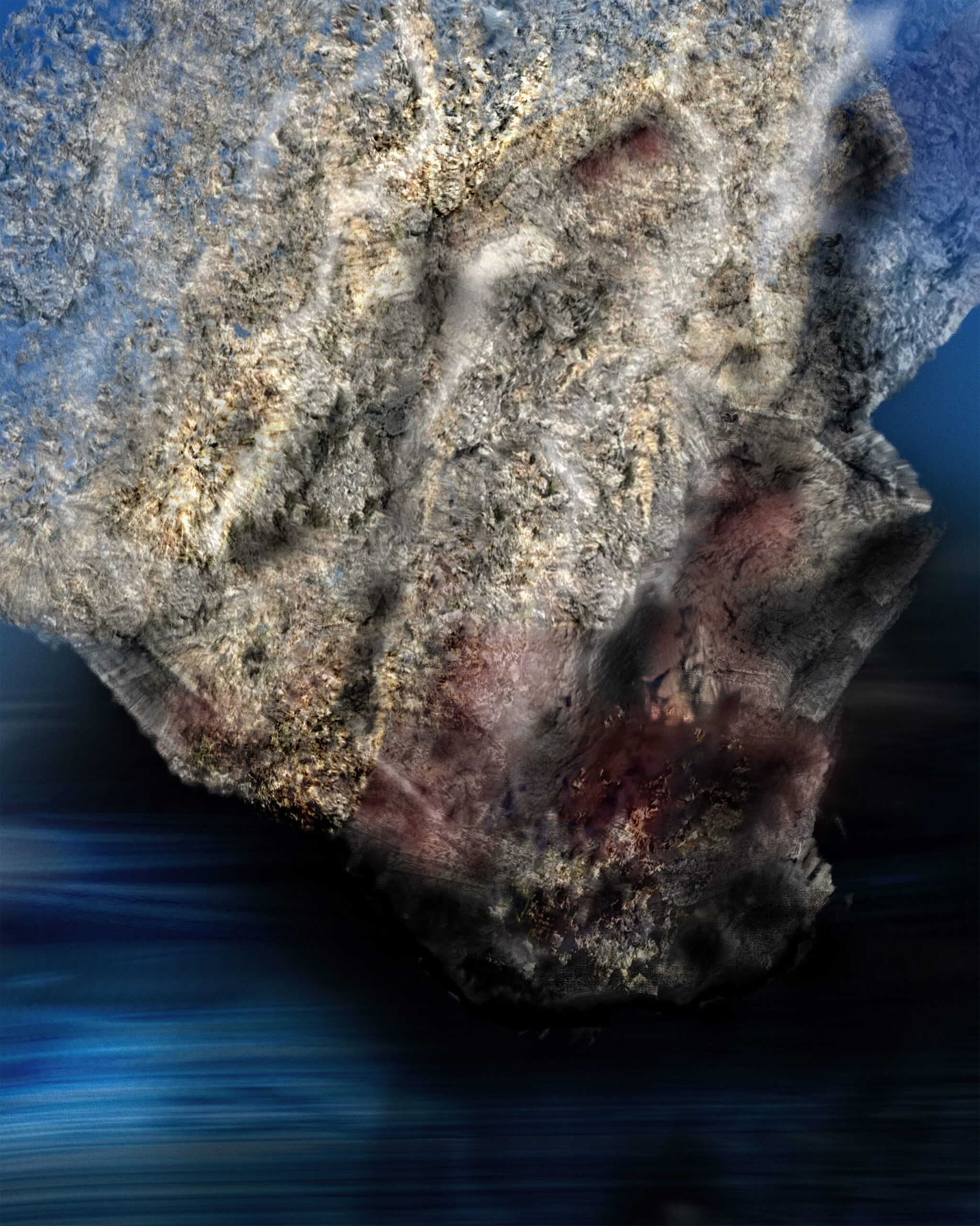
Abstract digital artwork titled Fallen Song showing a stone-like form suspended above deep blue water. Layers of mineral textures, muted reds, and diffused light suggest the moment when the siren Leucosia turns into stone. Digital glazes create the illusion of stone, water, and air merging.

Fallen Song

Fallen Song

Between stone and sky

My first impression of Fallen Song was the sense of a body falling. It is not a figure, but a form collapsing into itself. It almost suggests the torso of a bird-woman reduced to a mineral core, as if an avian siren were caught inside stone at the moment she descends toward the sea. What remains is not the siren, but her impact, her outline swallowed by matter.

The surface behaves like a skin that is coming apart. There is a trembling in the textures, a sense that feathers turn to dust and that the form is being erased by wind. This dissolution fits the direction of the Siren Series. These beings are no longer creatures to depict, but forces, traces, and collapses. They exist in the moment where myth shifts into erosion.

Below the falling form, the blue acts like a mythical threshold. The sea is never shown directly, yet its presence is clear. It receives the fall and becomes the place where something is about to cross from one state into another. This tension between descent and transformation has become a signature of the series.

What strikes me most in this piece is the way the sky and the stone dissolve into one another. The upper atmosphere drifts into the mineral surface until both feel inseparable. This unstable horizon suspends the siren between breath and matter. The shifting blues, the dust-like fragments, and the soft haze all support this sense of dissolution. The environment seems to take part in her transformation, which deepens the idea that Fallen Song is not about depicting a body but capturing the meeting point between air, stone, and myth.

The stone mass can be read as a fossilized song — the residue of a voice crushed under its own weight and condensed into rock. Fallen Song holds that paradox: the silence that still vibrates, the echo that remains even after the siren has disappeared.

Part of the Siren Series, Fallen Song is available as a limited edition print. Details can be found on the Unique Editions page.
You can also view related works on Singulart.