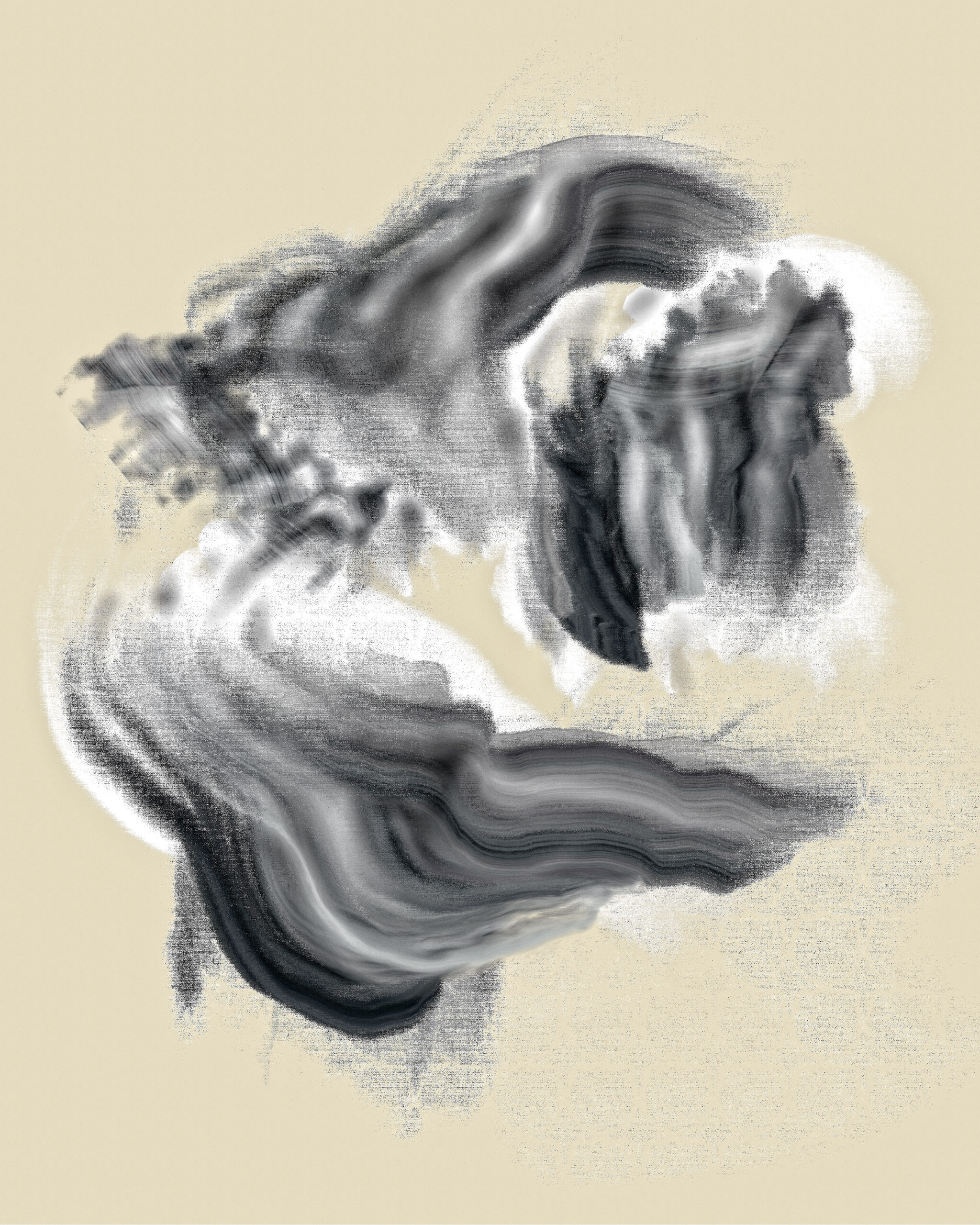
Paradox Rin I digital artwork exploring tension and circular movement in a suspended abstract field

Paradox Rin I

Paradox Rin I Digital Artwork: Tension Held in Circulation

Paradox Rin I digital artwork belongs to the Paradox series, a body of digital works that explores tension as a condition rather than an event. In this work, the image does not resolve into a stable form or symbolic structure. Instead, it remains suspended within a field of circulation, where movement is sensed but never completed.

Here, the visual energy of the composition is not organized around contrast or dramatic release. It gathers through repetition, curvature, and pressure. Forms appear to turn inward and outward at once, creating a structure that feels active without arriving at conclusion. The work does not present opposition in fixed terms. It sustains paradox as a living interval.

Colour operates with restraint. Soft neutrals, muted greys, and pale tonal shifts do not describe atmosphere or setting. They remain embedded within the surface, allowing density and flow to carry the image. Light is not used to reveal a subject. It moves through the work as a soft pressure, opening and closing perception without stabilizing space.

Abstract Digital Artwork — Paradox Rin I

Although the composition may suggest rotation, folding, or recurrence, these sensations do not become narrative. There is no figure, no location, and no symbolic anchor that would resolve the image into meaning. What persists instead is a state of contained movement, where the work appears to circulate around an internal centre that never fully declares itself.

This approach aligns with what I describe as a pedagogy of the gaze. Paradox Rin I resists quick interpretation and asks the viewer to remain with what is shifting but unresolved. Rather than offering a message, it invites sustained attention to rhythm, restraint, and the unstable balance between emergence and withdrawal.

Within a space, Paradox Rin I is not conceived as a decorative image. It functions as a quiet but active presence—an artwork that continues to reorganize perception over time. Its role is not to fill a wall, but to hold a subtle field of tension that remains open.

Paradox Rin I is available both through this site and on Singulart, allowing the work to circulate while remaining grounded in the conceptual framework of the Paradox series.

For information about print availability and formats, please refer to the Unique Editions section of the site.
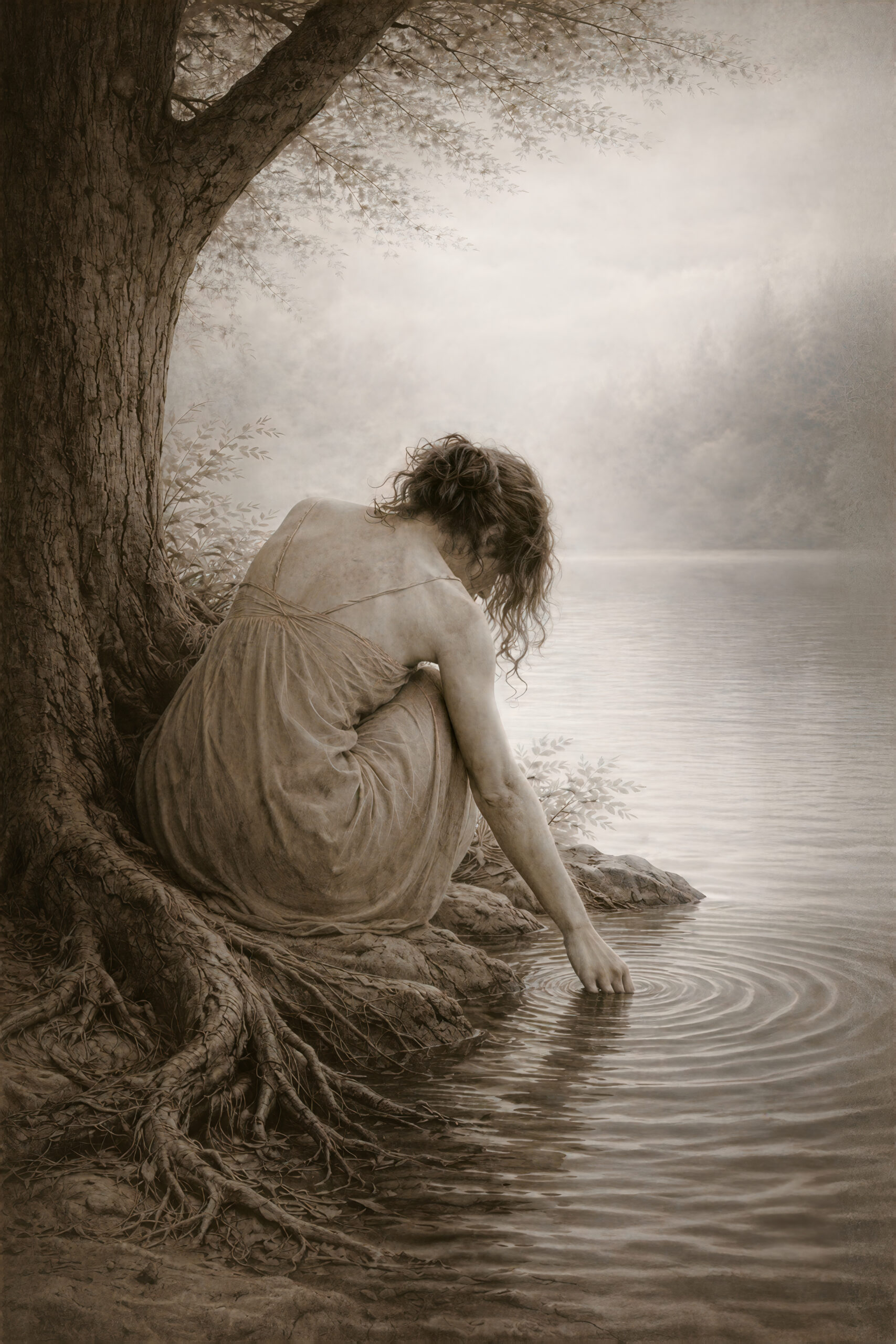


Paradox Rin I — Attraction Series, where the internal tension of the abstract work extends outward into a quiet relational scene, with a figure interacting subtly with water and atmosphere
Paradox Rin I — Attraction Series

From Paradox to Attraction

With Paradox Rin I — Attraction Series, a secondary state emerges from the abstract work. The internal tension, previously contained within the image, begins to extend outward and form a subtle relational field.

This image is derived directly from Paradox Rin I. The material structure remains continuous: density, tonal restraint, and chromatic balance are preserved, even as the image allows the emergence of a figure and a more perceptible environment.

The figure is not introduced as a subject, but as a point of orientation. Through her presence, elements such as water, light, and vegetation begin to align without fully stabilizing into a defined scene. The environment appears calm, yet something remains unresolved, as if a quiet interaction is taking place without clear cause.

This is not a transition toward narrative or representation. Rather, it marks a displacement—where abstraction begins to manifest as relation. The image remains suspended between internal tension and external attraction, allowing recognition without becoming fixed.
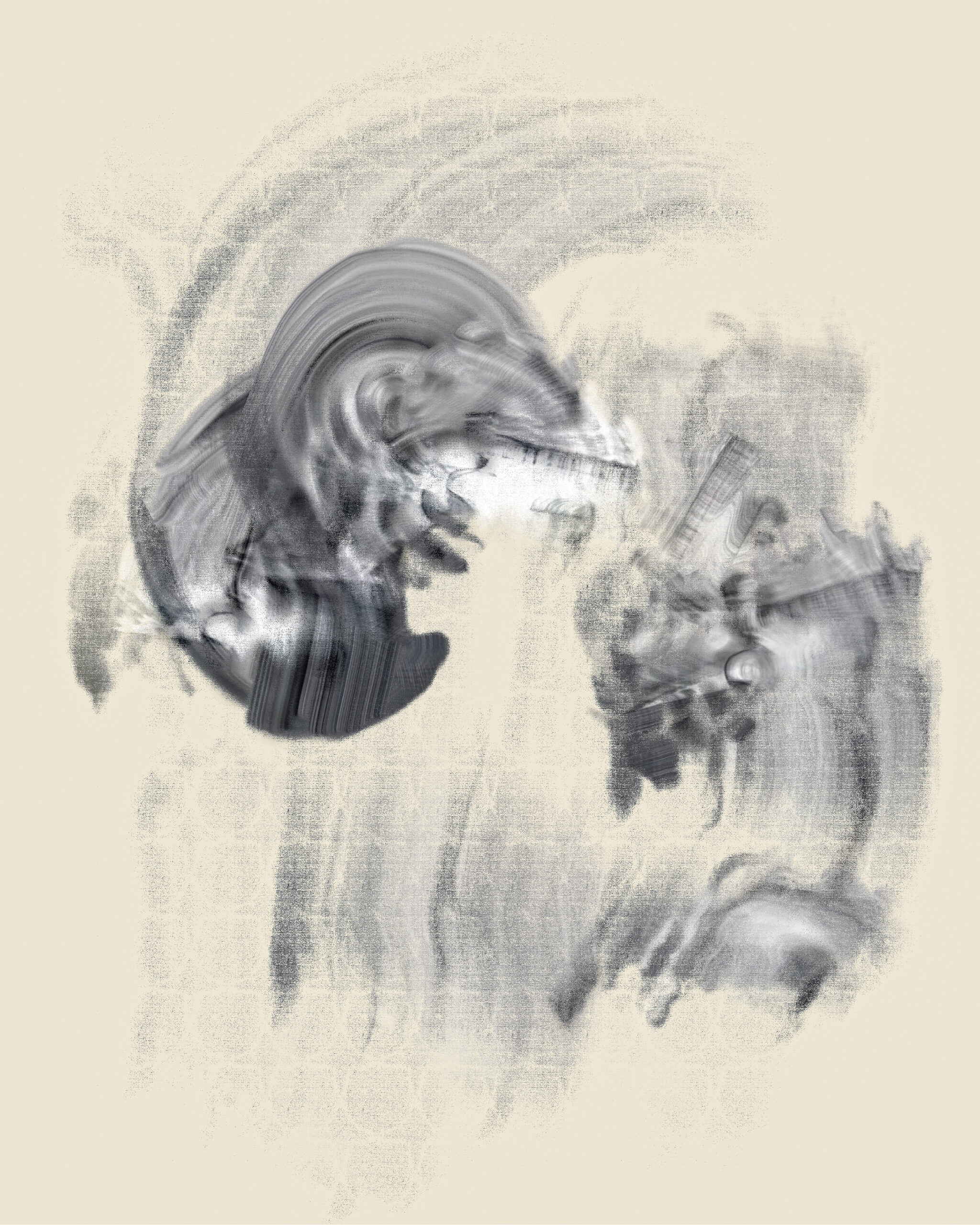
Paradox Ensō I by Denis Leclerc, abstract calligraphic digital artwork exploring an unstable circular gesture and suspended tension

Paradox Ensō I

Paradox Ensō I: The Circle That Refuses Closure

Paradox Ensō I belongs to the Paradox series, a body of digital works that explores tension as a sustained condition rather than a resolved form. In this piece, I approach the enso not as a symbol of completion, but as a gesture that remains unstable.

Instead of resolving into a clear circular form, the movement appears, thickens, and then begins to dissolve. The line does not settle. It resists closure.

The Unstable Gesture

A circular motion starts to emerge, yet it never fully completes itself. The gesture encounters resistance. It slows, fractures, and disperses. As a result, the form hovers between construction and erosion.

Rather than a controlled stroke, the image reveals a process. Layers accumulate, blur, and shift. Edges lose precision. The gesture no longer asserts mastery; it negotiates its own limits.

The Active Centre

In this work, the centre is not empty. It remains active and unstable.

What should function as a void instead becomes a field of tension. Surrounding forces shape it, but never define it. One impulse pushes toward continuity, while another interrupts it. This friction keeps the image open and unresolved.

Because of this, the work avoids becoming symbolic. It does not present a fixed meaning. Instead, it sustains a state of suspension.

This approach aligns with what I describe as a pedagogy of the gaze. Paradox Ensō I does not offer immediate clarity. It requires time. As the viewer lingers, perception adjusts, and the instability becomes perceptible rather than confusing.

Within a space, the work does not act as decoration. It operates as a presence held in tension. It does not complete the environment; it shifts it subtly over time.

For a broader understanding of this approach, see the Paradox Series.

For print availability and details, please refer to the Unique Editions section of the site.

Paradox Ensō I is also available on Singulart, allowing the work to circulate while remaining anchored in the evolving language of the Paradox series.


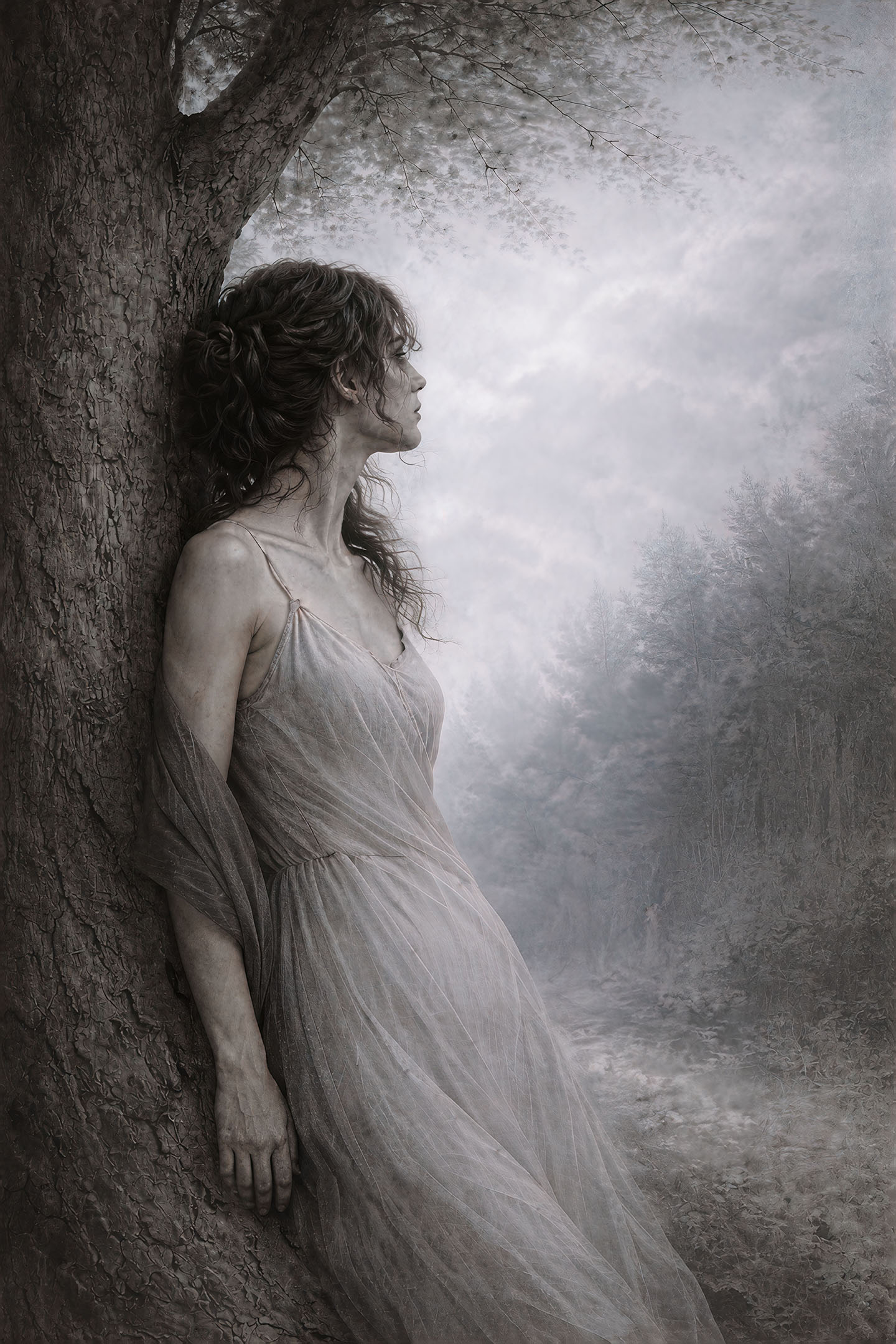
Attraction series derived from Paradox Enso I, where a seated figure at the edge of the water suggests a subtle field of relation, hidden response, and suspended desire
Paradox Enso I — Attraction Series

Emergence: Attraction

With Paradox Enso I — Attraction Series, a secondary state emerges from the abstract work. The objective is not to illustrate the paradox, but to observe what occurs when internal tension begins to extend outward and form a relation.

This image is derived directly from Paradox Enso I. What was previously held in suspension as a self-contained structure now appears to reorganize as atmosphere, gesture, and latent response. The work no longer operates only through internal contradiction. It begins to suggest an exterior field.

Unlike the abstract version, where tension remains unresolved within the image itself, Attraction Series introduces a figure and a landscape-like condition without allowing either to stabilize into narrative. The presence is not fully revealed, and the setting does not become a place in any descriptive sense. What appears instead is a relational threshold.

This is not a departure from the logic of Paradox Enso I, but a displacement of it. Tension becomes directional. The image begins to imply that matter, light, water, and vegetal forms are no longer neutral elements, but participants in a subtle field of attraction.

In this sense, Paradox Enso I — Attraction Series does not stand apart from the original work. It exists as a secondary reading: a state in which paradox no longer remains entirely enclosed, but begins to manifest as response, invitation, and withheld presence.