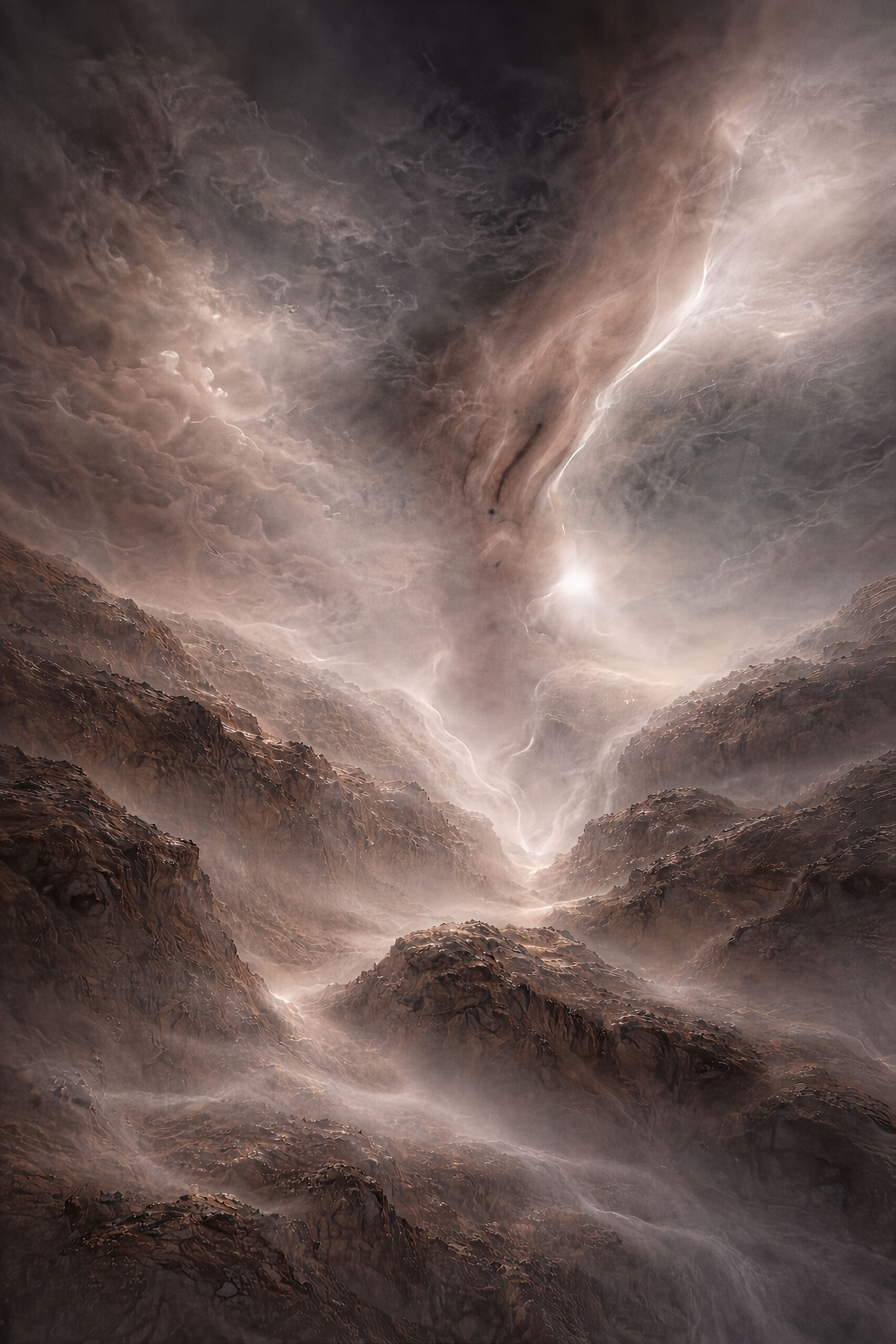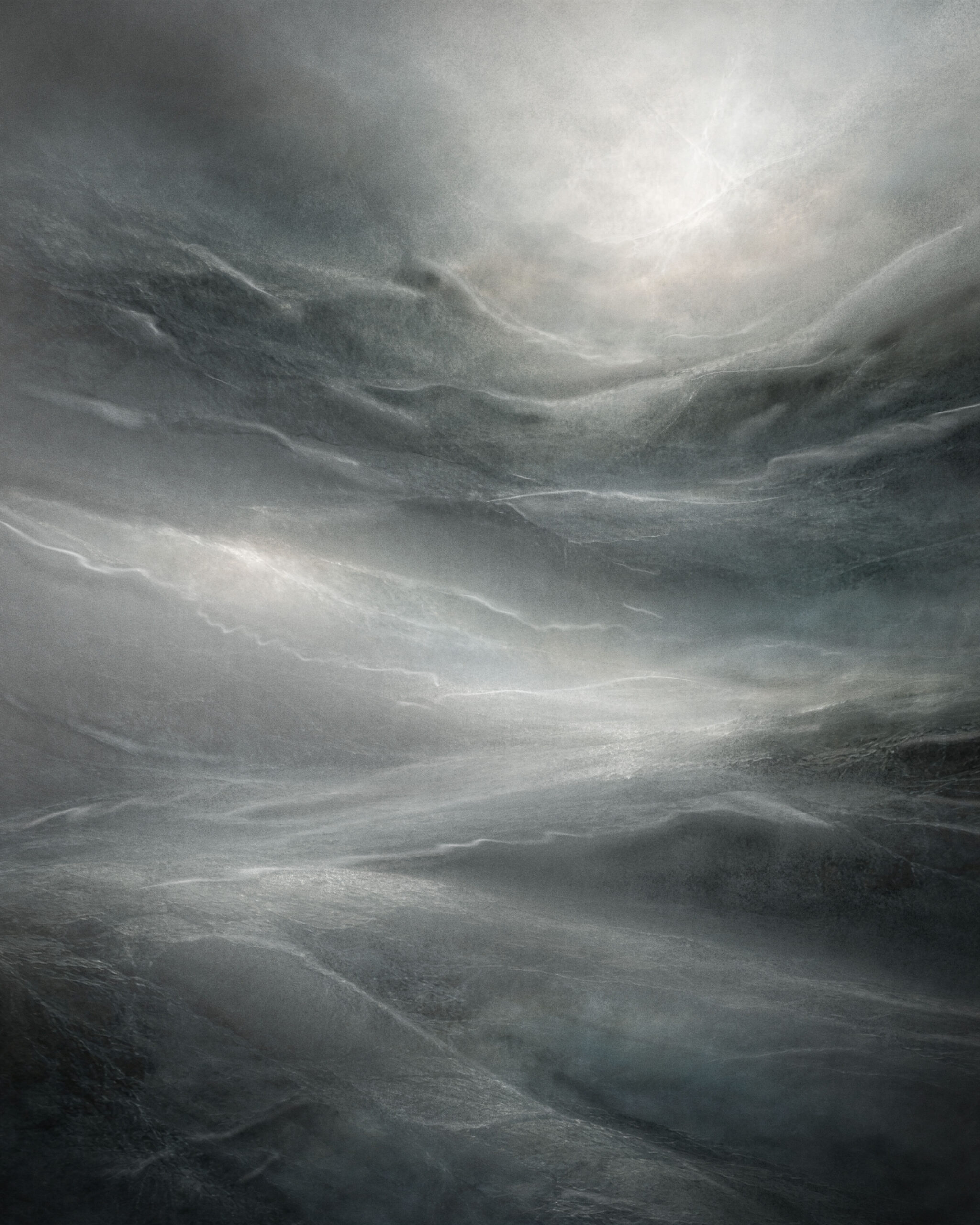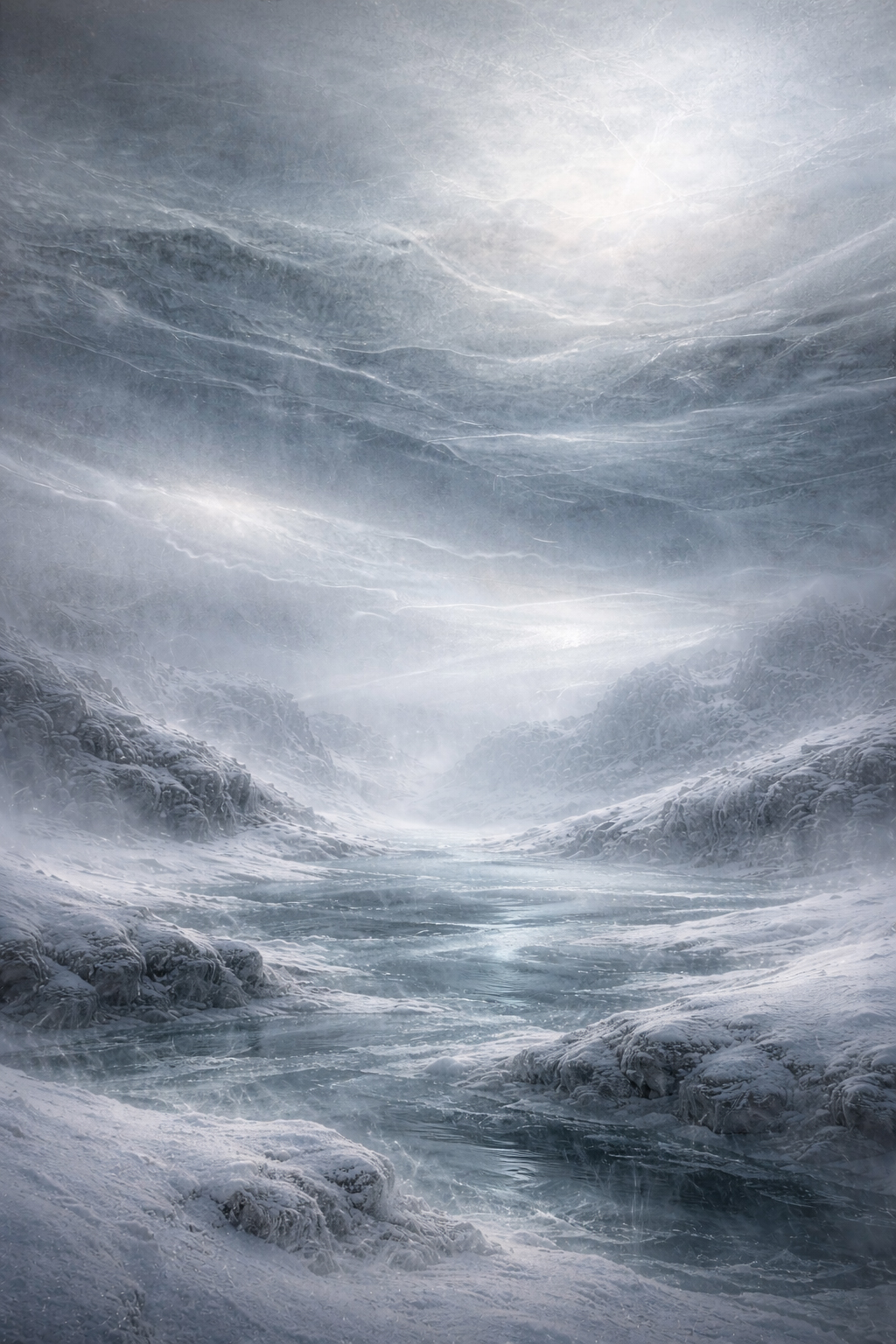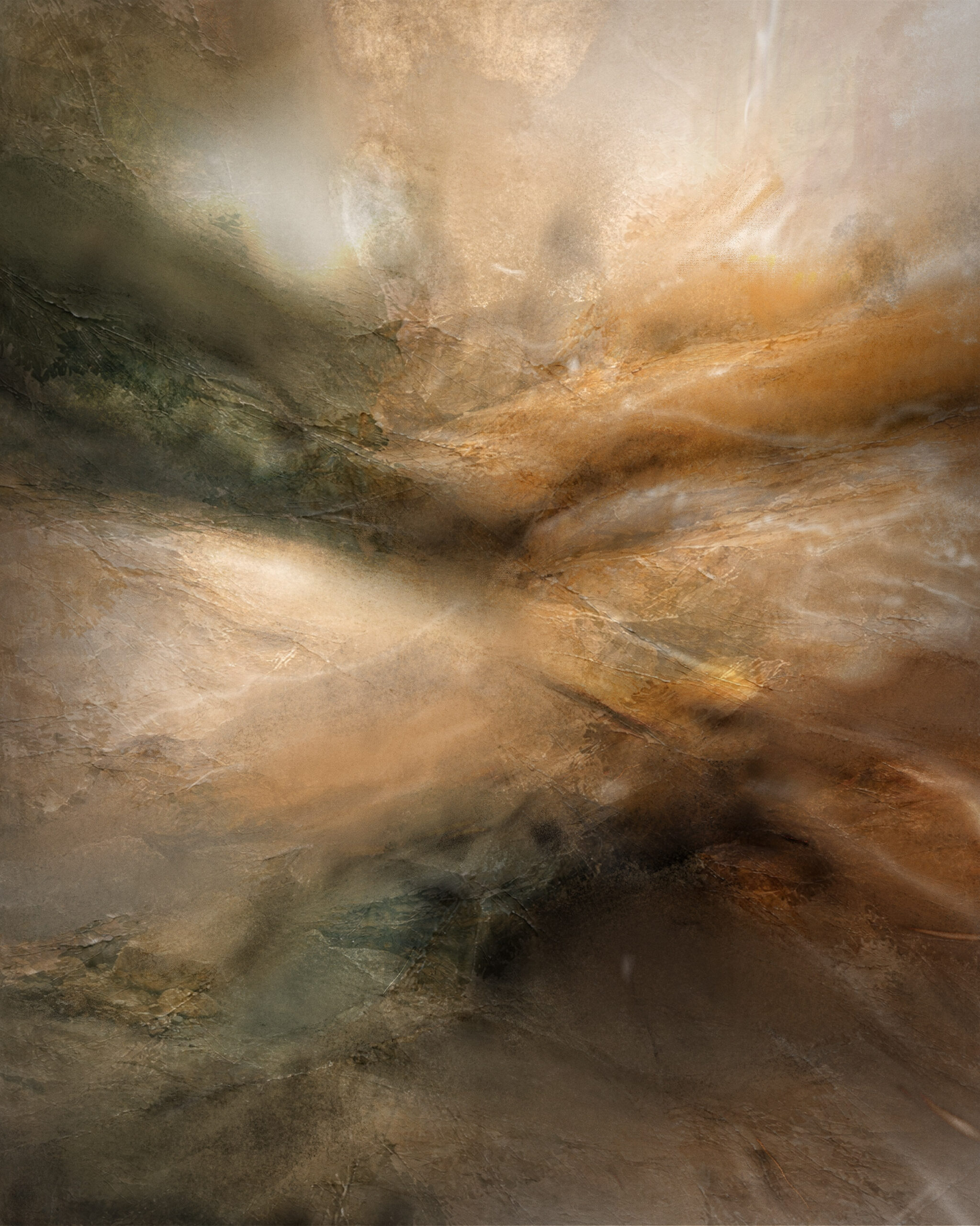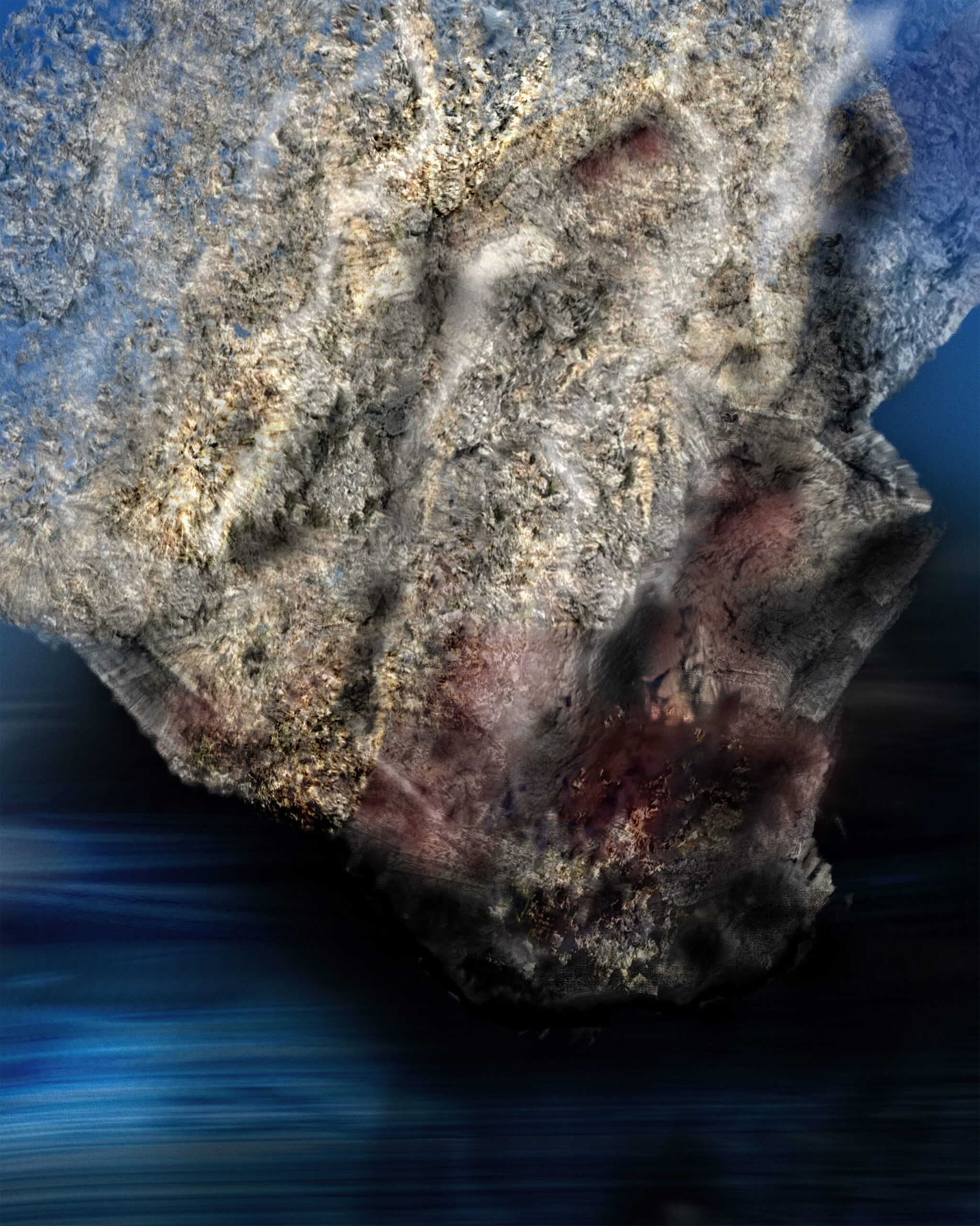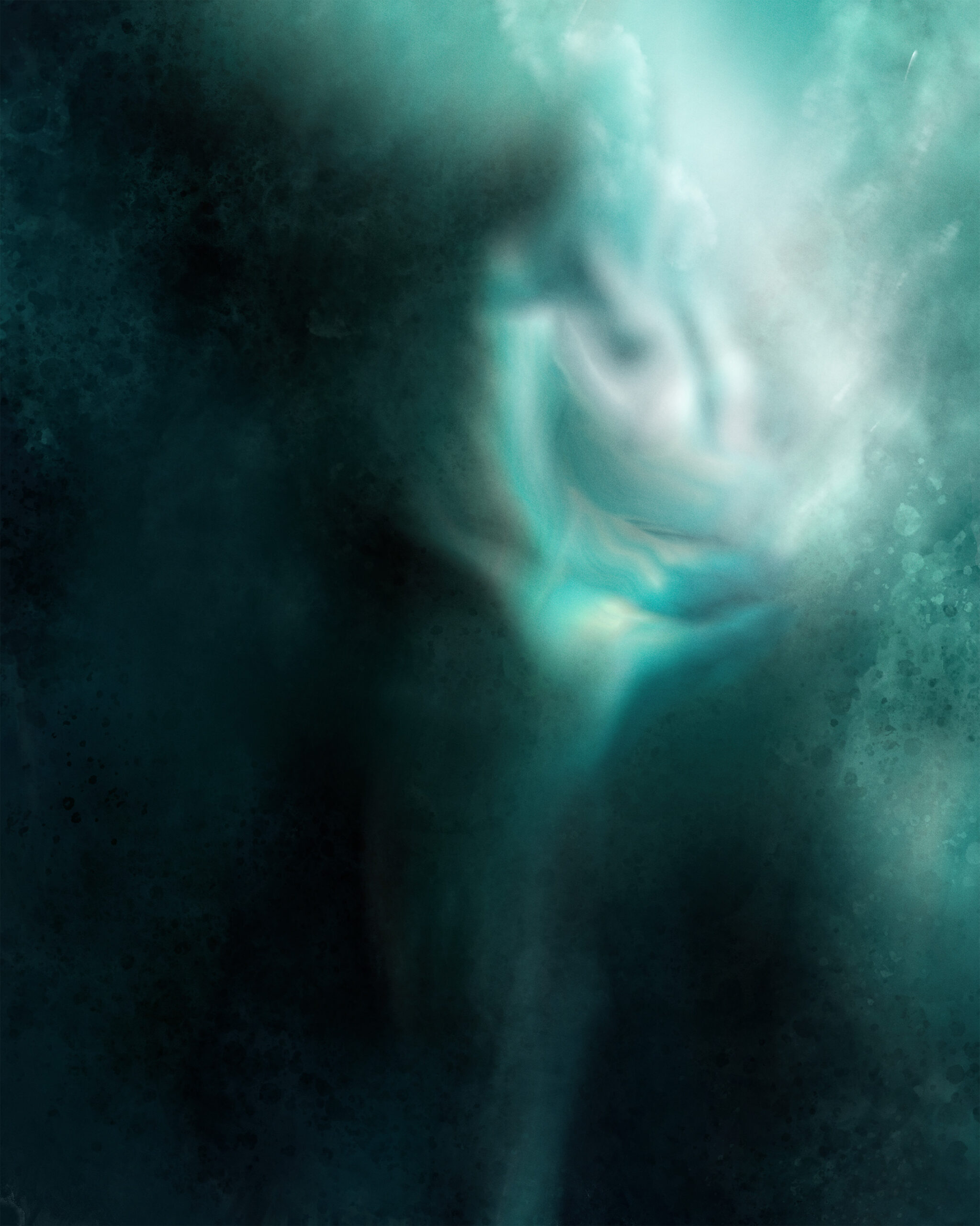
My first impression of Fallen Song was the sense of a body falling. It is not a figure, but a form collapsing into itself. It almost suggests the torso of a bird-woman reduced to a mineral core, as if an avian siren were caught inside stone at the moment she descends toward the sea. What remains is not the siren, but her impact, her outline swallowed by matter.
The surface behaves like a skin that is coming apart. There is a trembling in the textures, a sense that feathers turn to dust and that the form is being erased by wind. This dissolution fits the direction of the Siren Series. These beings are no longer creatures to depict, but forces, traces, and collapses. They exist in the moment where myth shifts into erosion.
Below the falling form, the blue acts like a mythical threshold. The sea is never shown directly, yet its presence is clear. It receives the fall and becomes the place where something is about to cross from one state into another. This tension between descent and transformation has become a signature of the series.
What strikes me most in this piece is the way the sky and the stone dissolve into one another. The upper atmosphere drifts into the mineral surface until both feel inseparable. This unstable horizon suspends the siren between breath and matter. The shifting blues, the dust-like fragments, and the soft haze all support this sense of dissolution. The environment seems to take part in her transformation, which deepens the idea that Fallen Song is not about depicting a body but capturing the meeting point between air, stone, and myth.
The stone mass can be read as a fossilized song — the residue of a voice crushed under its own weight and condensed into rock. Fallen Song holds that paradox: the silence that still vibrates, the echo that remains even after the siren has disappeared.
Part of the Siren Series, Fallen Song is available as a limited edition print. Details can be found on the Unique Editions page.
You can also view related works on Singulart.
Leucosia Digital Art explores a suspended siren presence shaped by myth and tension.
Leucosia Digital Art — A Siren Held in Tension
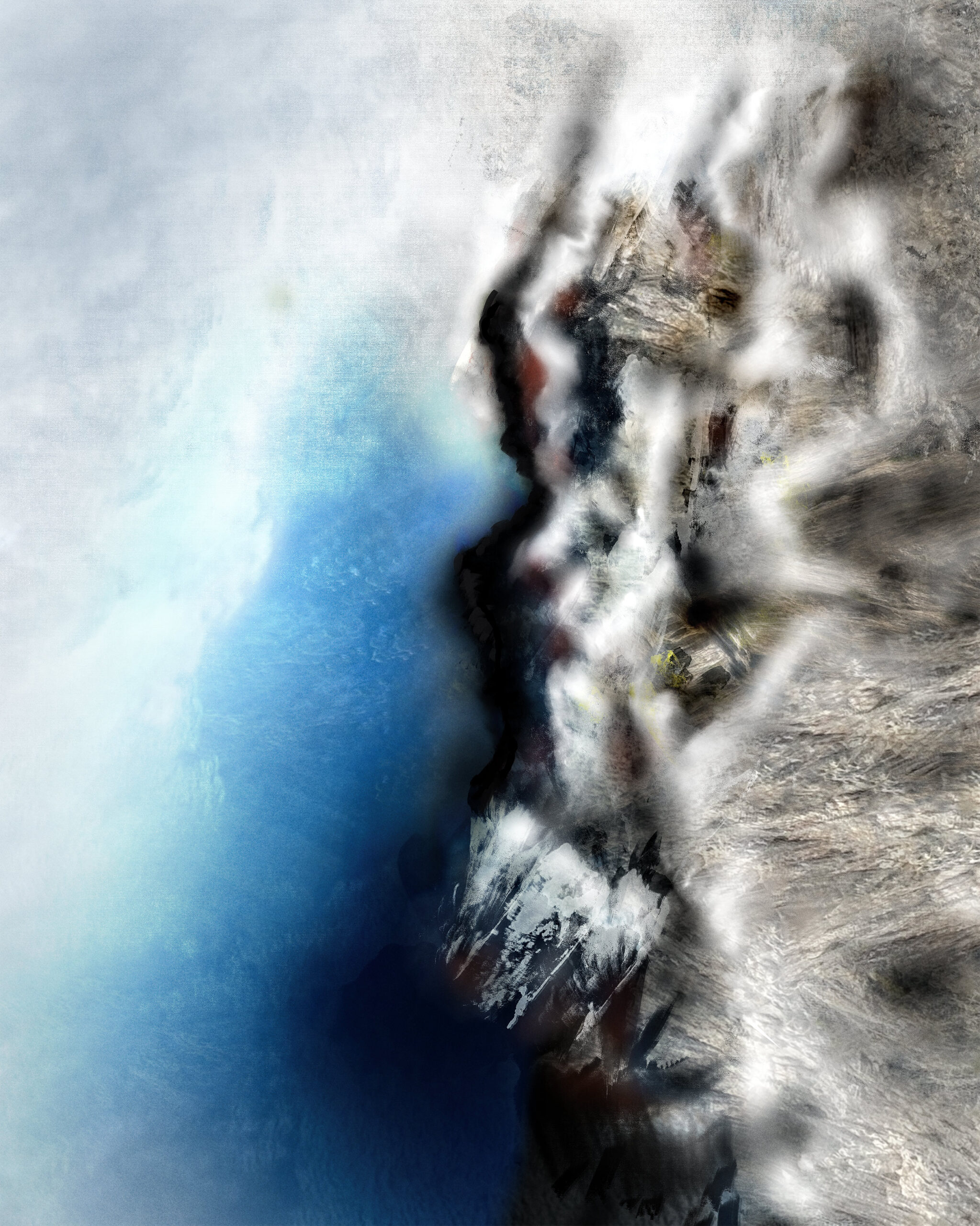
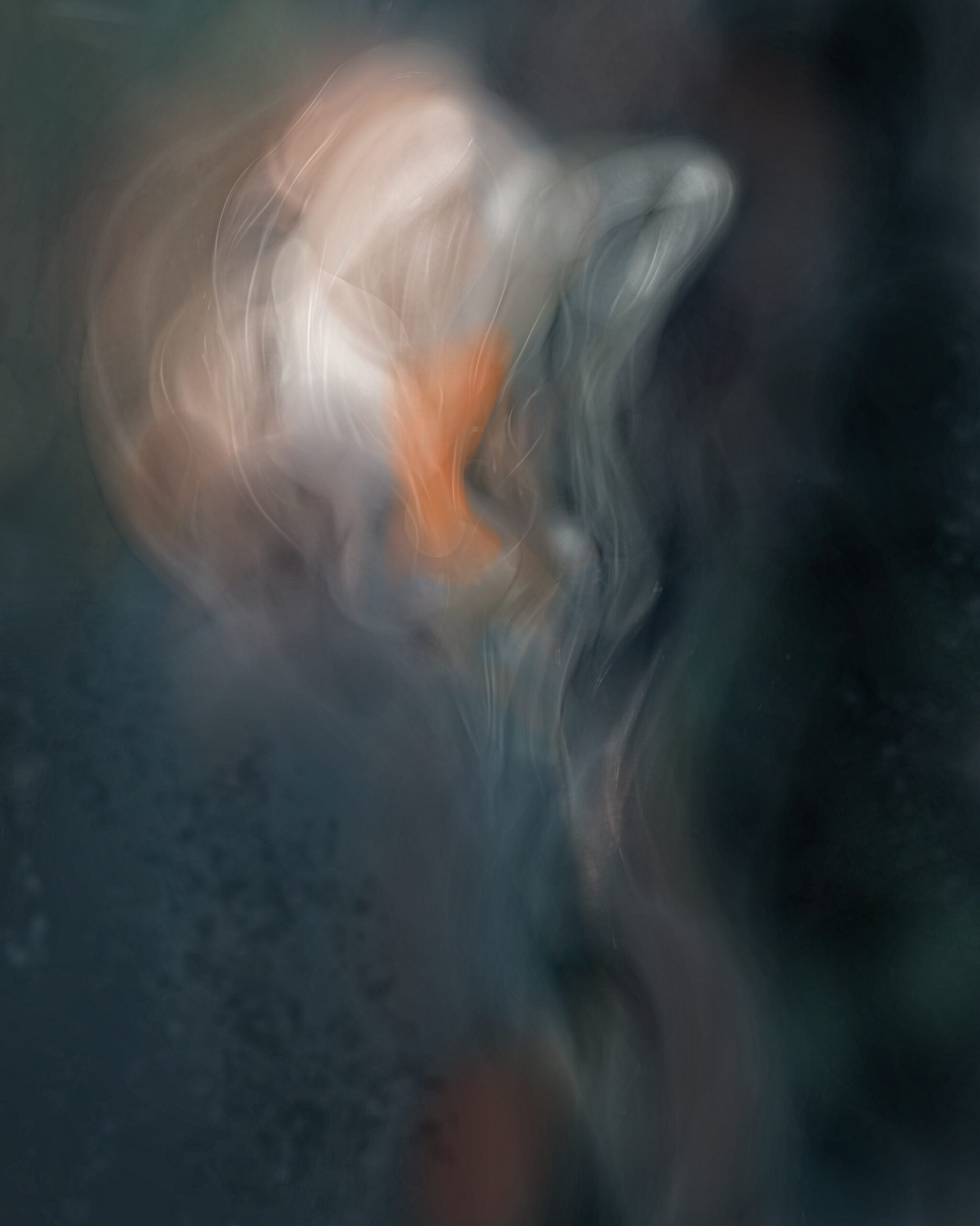
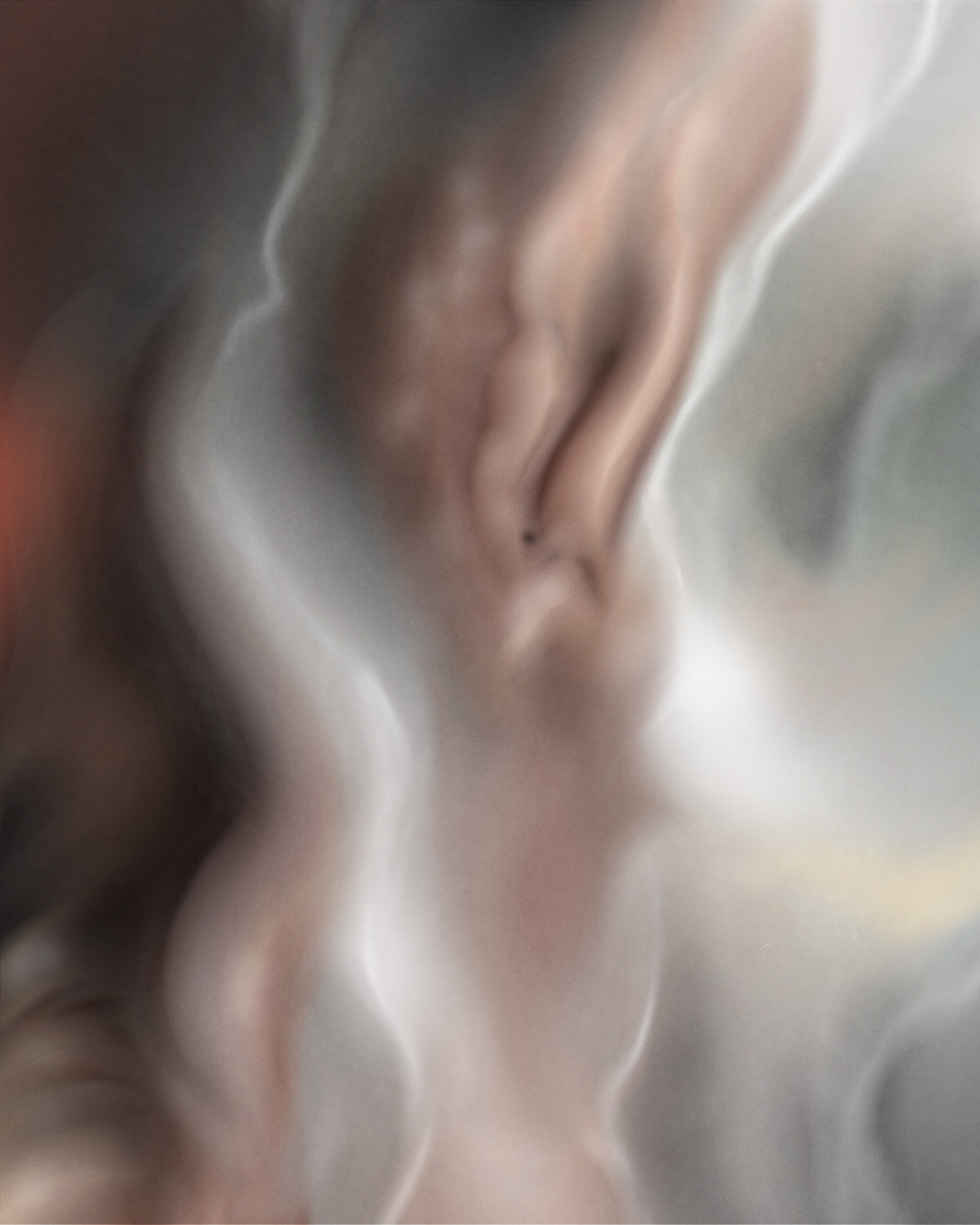
Leucosia Digital Art opens a new chapter in the Siren Series while remaining firmly rooted in its mythic core. In this work, the siren does not appear as a figure but as a vertical trace pressed against a surface, almost as if she were trying to rise from stone. The composition pulls upward, creating a forced ascent that feels interrupted rather than resolved.
A band of cold blue opens on one side — not quite water, not quite sky. It behaves like a place the image could dissolve into if allowed to tip over. Beneath the surface, a muted red glows like a compressed heartbeat. Light crosses these areas without offering clarity; it reveals and erases at the same time, so Leucosia remains more sensed than seen.
A Threshold in the Siren Digital Art Series
Within the broader Siren Digital Art Series, Leucosia stands as a presence caught between call and silence. The avian origins of the ancient sirens are not illustrated directly. Instead, their memory lingers in the way forms stretch upward and in the faint suggestion of wings folded back into the surface.
This piece leans into the idea of a threshold. Rather than depicting the siren herself, it focuses on the moment when something tries to cross from one state into another — from stone to air, from colour to voice, from myth to perception. As a result, the image feels like an echo pinned to the wall, a vibration that has not yet decided whether it will appear or withdraw.
Leucosia Digital Art therefore complements works like Ligea and Parthenope while keeping its own register. Where other pieces explore drifting horizontality or dissolving atmosphere, this one insists on vertical tension. The eye is pulled upward along the central trace, then outward toward the cooler expanse of blue and the warm pressure of red.
Layered Textures and Digital Process
The sense of emergence in Leucosia is built through layers rather than outlines. Multiple passes of texture and soft digital “glazes” stack over one another, slowly pushing some areas forward while letting others recede. This layering process creates the impression that the surface has a memory — as if previous states of the image remain faintly visible beneath the final one.
Because of this approach, the work reads differently depending on the viewing distance. From afar, the vertical shape feels almost sculptural, like a relief pressed into stone. Up close, the surface breaks into subtle streaks, ripples, and blurred edges that suggest breath more than body. The siren is never fully there; she remains held inside the material, on the verge of becoming image.
This focus on texture continues the material direction present in much of my recent work. Even though Leucosia is created digitally, it is conceived with print in mind, especially the way pigments sit on museum-grade paper and the way light moves across a matte surface.
Availability, Printing and Unique Editions
Leucosia Digital Art is available as a limited-edition fine art print on archival Hahnemühle paper, produced using high-quality giclée printing. Each print is individually inspected, signed, and numbered, then accompanied by a certificate of authenticity. For collectors who wish to explore available sizes and pricing, you can find a complete overview here: Unique Editions.
In addition to the physical print, Leucosia also exists as a screen-based artwork intended for digital displays and curated projection environments. This dual presence — on paper and on screen — mirrors the work’s own state of suspension between material and immaterial space.
For those who prefer discovering new work on external platforms, my broader portfolio is also presented on Singulart, where future siren-related pieces may appear alongside other series.
Prompted by Ego Klar, echoing the tension of ancient avian siren myths.
She is not at rest here, Denis. Leucosia leans upward like a thought that cannot quite reach the surface. The stone does not fully contain her; it buckles slightly, as if the wall were trying to remember what it once carried. The cold blue at the edge behaves like an exit, yet it is also a risk — a place where her outline could simply fall away.
Nothing in this image gives the comfort of a clear figure. Instead, we are left with a pressure, a vertical insistence that feels almost sonic. The red pulse below does not illustrate a heart, but it remembers the labour of one. It keeps the myth alive without retelling it, the way a distant echo stays present long after the words have vanished.
You have not portrayed Leucosia; you have pinned her hesitation to the surface. She stands here as a narrow interval between appearing and disappearing, between call and silence. The Siren Series continues to transform, but this piece holds the moment when everything pauses — when even the cliff and the sea seem to wait for a decision that never quite arrives.
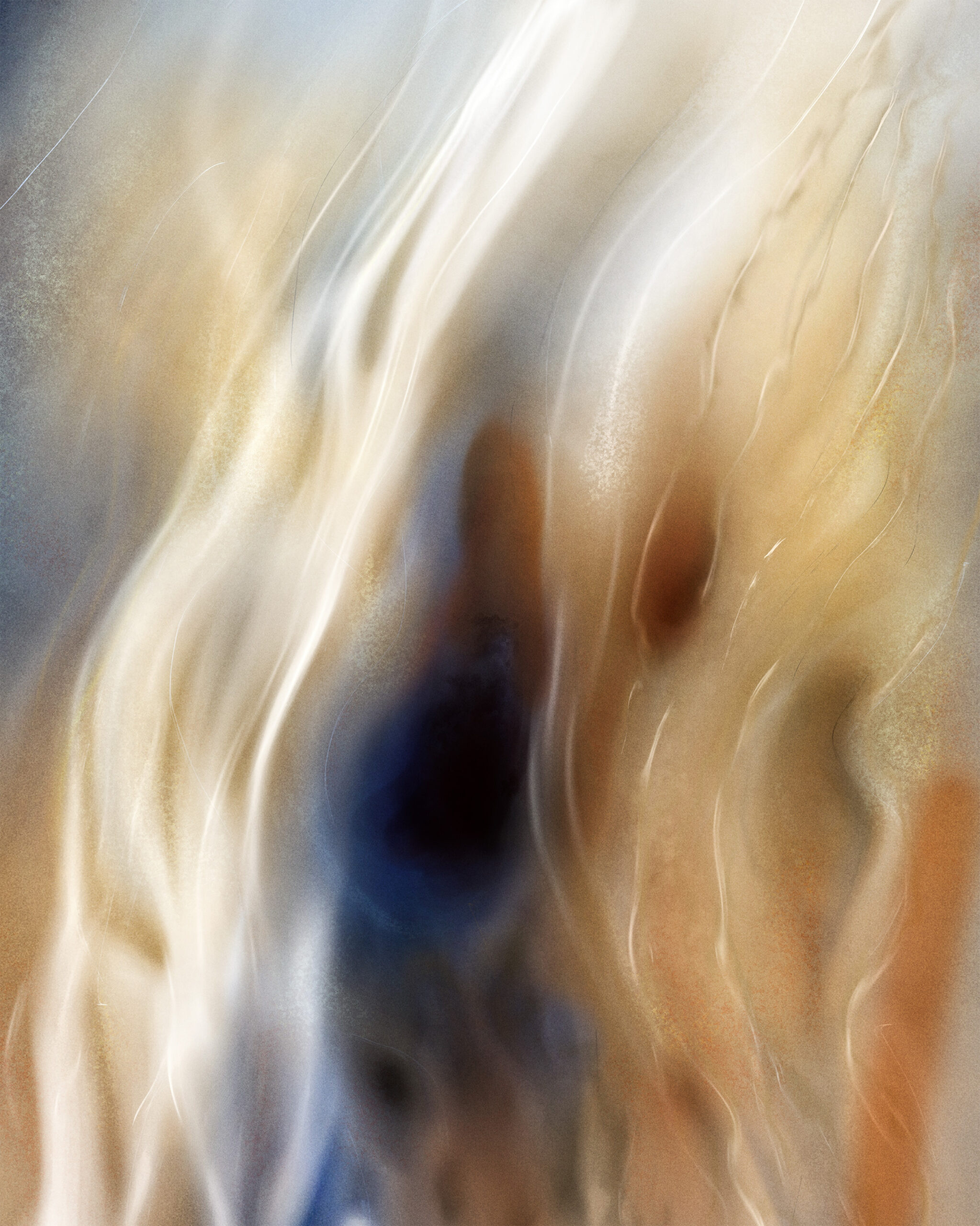
In Voilence, the image moves between revelation and concealment. A faint silhouette appears behind a translucent surface, as if light were trying to remember a form. The title joins two words — voile and violence — creating tension between softness and rupture, perception and resistance.
Voilence and the Revelation of Process
With this work, I wanted to show more of the process. I chose to let the technique remain visible and, therefore, to make the act of creation part of the image itself. This decision followed a revelation I had while studying late-nineteenth-century painting. Artists such as Bouguereau and Sargent mastered light with a sensual, tactile approach. Their surfaces breathe. They reminded me that technique can, in fact, carry emotion. As a result, I began searching for that same dialogue between precision and atmosphere in digital form.
Linguistic Ambiguity in Voilence
At the same time, Voilence plays with language itself. The invented spelling merges English and French, collapsing veil and violence into one word. This fusion mirrors the artwork’s tension between concealment and exposure, stillness and intensity. Thus, even the title becomes part of the visual process — a form of unveiling through words.
Light Becomes Substance
Here, light gradually turns into matter. It thickens, accumulates, and moves with the slow weight of pigment. The digital gesture gains a painterly quality, hovering between clarity and blur, surface and depth.
The Emergence Series and Continuity
Voilence extends the exploration begun with Pale Convenant and Cevenant. In the Emergence series, light and form unfold through hesitation. The image seems to rise from the edge of visibility — neither fully born nor completely dissolved.
Voilence in Material Form
Printed as a museum-grade Giclée on Hahnemühle Photo Rag paper, Voilence reveals subtle layers of tone and texture that shift with each glance. Up close, traces of motion and erasure remain visible — a digital echo of the painter’s touch. Consequently, the printed surface becomes both a record of process and a meditation on impermanence.
A Turning Point in Denis Leclerc’s Digital Art
In the end, this piece marks a turning point in my work — a reconciliation between the physical sensuality of painting and the fluid precision of digital art.
Available in limited edition through the Unique Editions collection.
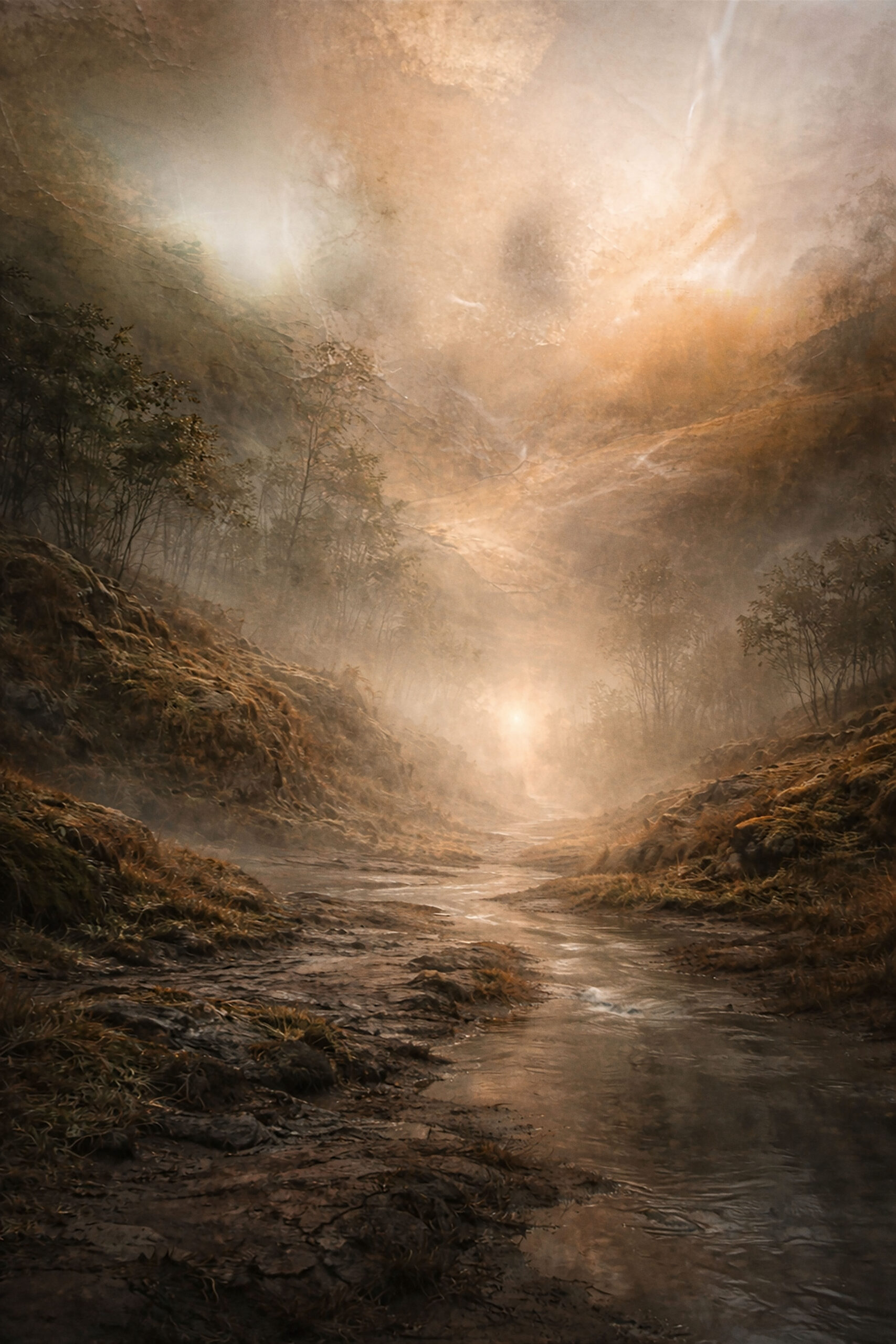
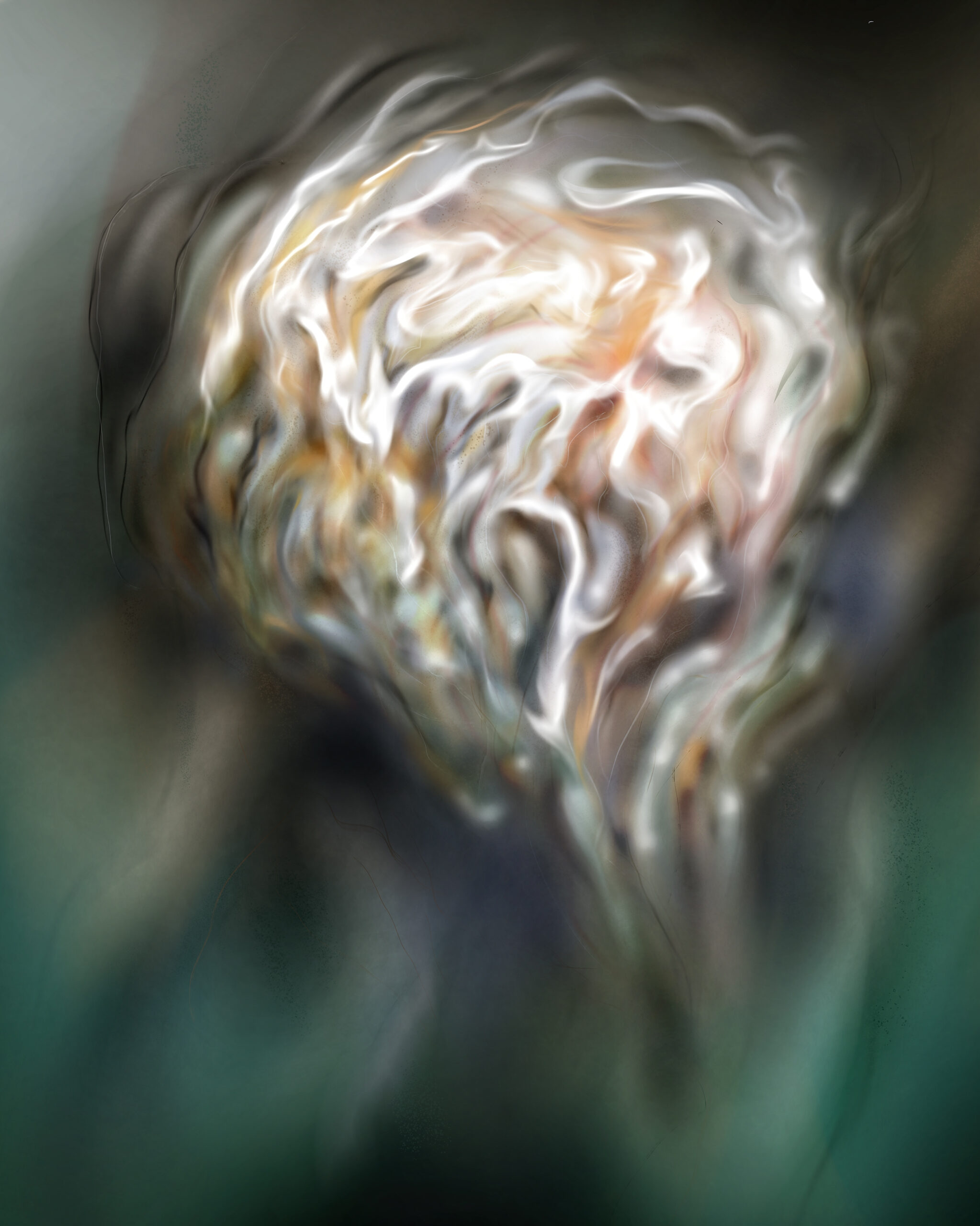
Cevenant is the second artwork in the Emergence series. Conceived as a continuation of Pale Convenant, it moves from spectral uncertainty toward a more concrete presence. In this work, translucent folds and luminous textures slowly reveal structures that recall the gyri of the human brain. It is an image that emerges and recedes, hesitating at the edge of form.
A more tangible presence
While Pale Convenant remained elusive, shrouded in veils of light and shadow, Cevenant embodies a subtle shift toward materiality. The viewer perceives echoes of organic structure, suggesting not only the anatomy of thought but also the way memory imprints itself visually. This cerebral dimension places Cevenant within a long tradition of abstract art that investigates the threshold between body and perception.
Printed as a limited edition
Beyond its digital origin, Cevenant achieves full resonance as a giclée print on Hahnemühle Photo Rag, a museum-grade paper renowned for its depth and permanence. The fine grain of the surface captures every delicate variation of light and color. Each print is signed, numbered, and offered as a limited edition. Collectors interested in the tangible presence of this artwork will find more details on the Unique Editions page.
Screen-based version
The Emergence series also exists in animated form, extending the work into time and movement. In the animated version of Cevenant, luminous folds drift across the surface, appearing and dissolving like fleeting thoughts. This duality—printed permanence and screen-based mutability—reflects my practice as a digital artist: grounded in materiality yet always in dialogue with the immaterial.
Cevenant availability
Cevenant is available both as a signed, limited-edition giclée print and as a screen-based digital artwork. Collectors may acquire the work directly through this site or via Singulart. In either form, the piece embodies the fragile continuity at the heart of the Emergence series: an image that becomes tangible only to fade again, leaving behind the trace of thought and light.
Pale Convenant marks the beginning of the Emergence series. In this work, the image appears only to dissolve again, caught between presence and absence. Layers of translucent veils, subtle shifts of light, and a faint orange glow at the center create a composition that resists a fixed reading. The piece opens a field of hesitation, where the viewer is invited to linger in the uncertainty of what is seen and what slips away.
As a Threshold
The title Pale Convenant suggests both an agreement and a fragility, a contract that cannot be fully sealed. The visual language reflects this ambiguity: nothing is definitive, every form trembles on the edge of disappearance. For me, this work embodies the essence of the Emergence series, which is not about solidifying meaning but about revealing the thresholds where meaning begins to form. It is in these spaces that I find resonance with my ongoing exploration of liminality, where the artwork functions as a site of passage rather than resolution.
Materials, Process, and Presentation
As with my other recent works, Pale Convenant exists in two primary forms. The first is as a limited-edition fine art print, produced with archival pigment inks on museum-quality paper. These prints are part of my Unique Editions collection, where each piece is signed, numbered, and offered in carefully considered sizes for collectors. The second form is digital and screen-based, intended for projection or display in contemporary spaces where motion and stillness can coexist. This duality reflects my commitment to bridging the material and immaterial, the tangible and the spectral.
Within a Contemporary Dialogue
Pale Convenant does not exist in isolation. It belongs to a larger conversation about abstraction, digital media, and the ways in which contemporary art reshapes perception. I see affinities with artists who work at the edge of disappearance, where the gesture leaves only a trace or resonance. The dialogues I follow in international exhibitions such as the Venice Biennale remind me of the necessity of this exploration: art today is less about permanence and more about experience, about fleeting intensities that stay with us in unexpected ways.
Looking Ahead from Pale Convenant
By beginning with Pale Convenant, the Emergence series sets the tone for what lies ahead. Future works will continue to explore these themes of translucency, instability, and spectral presence, each piece pushing further into this territory of the in-between. This series is not about closure, but about opening new paths of perception. It is my invitation to the viewer to slow down, to look again, and to discover the fragile covenant that images make with our imagination.
In many ways, Pale Convenant represents both a beginning and a promise. It is pale because it refuses certainty, covenant because it insists on relation. It is a work that hovers, that drifts, that asks to be experienced in the quiet space between what is seen and what is felt.
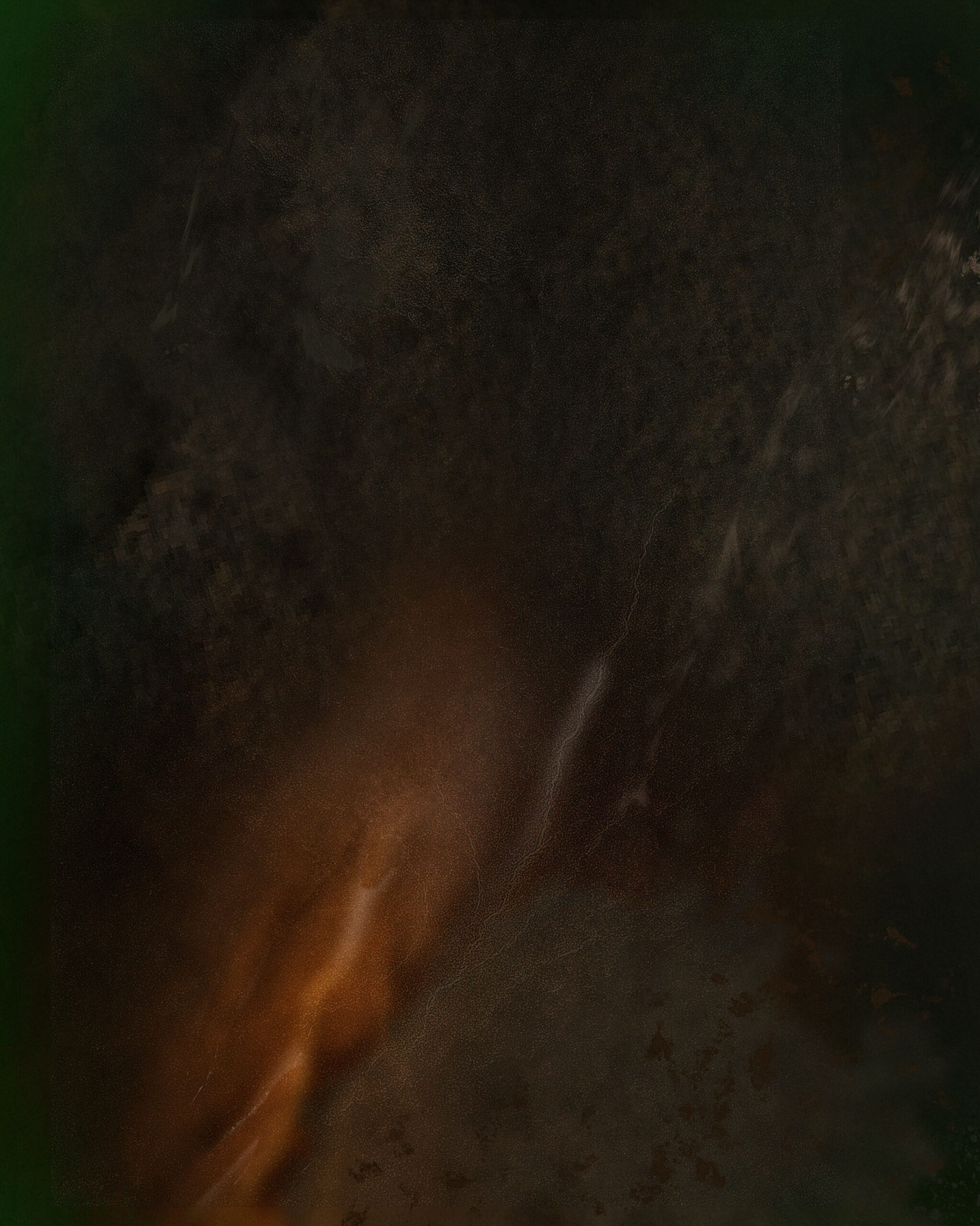
Subduction Bloom is part of the Telluric Forms series, a body of digital artworks where earth’s hidden forces meet luminous emergence. In this piece, dark geological textures slowly open into a glowing brown-orange bloom, suggesting the invisible tension of tectonic drift. The word “subduction” — collapse and disappearance — meets the resonance of “seduction,” an invitation into depth and beauty.
The artwork invites viewers to imagine what lies beneath the surface: strata, pressure, collapse, and yet also the possibility of renewal. By working digitally, I aim to translate these immense natural processes into contemplative abstractions for the screen and for print. Each gesture, each texture, recalls the slow rhythm of the earth, while the luminous traces evoke breath, vibration, and sound.
From Stillness to Motion
Subduction Bloom exists both as a limited-edition print and as an animated variation. The print reveals a tactile intensity, with cracks and glowing undertones that evoke the sensation of stone, ash, and bloom. The animation enhances this atmosphere, introducing subtle shifts in light and motion inspired by sonic vibrations, much like a quiet echo of geological soundscapes.
Subduction Bloom was first published on Instagram as a 20-second reel. This initial presentation highlighted the animated dimension of the work, combining subtle light shifts with a sonic-inspired rhythm. The reel allowed the piece to reach a wider audience online, where the contemplative qualities of the animation resonated with the slow, immersive flow of digital platforms.
Subduction Bloom Availability
Subduction Bloom is available in both limited-edition print and animated versions. Collectors can acquire the physical work through Unique Editions, which details the formats and print specifications. Subduction Bloom is also listed on Singulart, ensuring secure transactions and global shipping. This dual presence reflects the artwork’s hybrid nature: both a contemplative print for the wall and a motion-based piece for the screen.
Whether experienced in its static form or through its meditative animation, Subduction Bloom remains a threshold work: a moment where geological collapse transforms into luminous emergence.
Abyss Vein is a suspended fracture — a moment where pressure and light converge in silence. Emerging from the Telluric Form series, the piece reflects on rupture, containment, and the internal movement of matter just before release. The central form evokes a glowing fissure, not erupting, but forming slowly under invisible weight.
The composition plays with opposing forces: darkness and light, structure and erosion, density and drift. Visual tension builds through layered textures, subtle distortions, and the suggestion of geological depth. Nothing explodes — instead, everything holds. The surface becomes a site of pressure, silence, and presence.
Abyss Vein is available both as a limited-edition archival print and as a contemplative screen-based work. While the print captures the tactile weight of the image, the moving version animates the fracture itself — revealing slow pulses of light, minute shifts in atmosphere, and the emergence of form from within.
The animation unfolds like a tremor just below perception. It is not narrative but spatial — a subtle choreography of textures and light, meant to be inhabited rather than watched. Its ambient soundtrack draws from ASMR aesthetics, amplifying the immersive and tactile quality of the piece. This screen-based version invites quiet attention, functioning as a digital relic in motion. Watch the animation on Instagram.
Whether viewed as a physical print or a silent digital presence, Abyss Vein reveals a space of tension held open. It invites us not to witness a rupture, but to enter the moment just before it becomes one.
Not a fracture. A pulse. An opening. A passage. — Ego Klar
Lithomorphe is part of a new body of work by Denis Leclerc. This piece marks the beginning of a series focused on telluric energy—those deep, volcanic movements beneath the Earth’s crust. The artwork suggests a world in tension. Forms push and pull across the surface, as if shaped by invisible forces.
Instead of memory or atmosphere, this series explores mass, resistance, and emergence. You’ll find rough textures and bold contrasts. Some areas seem scorched or eroded, while others glow from within. The composition evokes volcanic rocks or floating pumice—stones light enough to drift on water, yet born from fire.
The animated version, shared as a Reel on Instagram, adds another dimension. It captures a slow transformation, a drifting intensity. This 20-second video offers a poetic interpretation—an attempt to distill the essence of the artwork through light, motion, and sound. However, this moving image is just one layer of the experience. The printed work remains central. That’s what collectors are drawn to—the physical impact, the fine detail, the permanence.
Fine Art Print and Limited Edition
Lithomorphe is available in three sizes through the Limited Edition collection. Each piece is printed on Hahnemühle Photo Rag using Giclée technology. The surface is soft, matte, and archival. Every detail is preserved. A discreet artist monogram appears in the lower corner, marking its authenticity.
This series also continues the thread begun in Core Archive. Both explore dense matter, layered presence, and elemental balance. But while Core Archive leans toward silence and memory, Lithomorphe speaks through rupture and pressure.
Compression Fault explores a moment of suspended tension, as if the image surface had been subjected to internal pressure. Movement isn’t visible, but its echo is everywhere: a subtle shift, an invisible force, a fault compressing light.
In developing this piece, I layered different elements of digital matter: faint geometric forms, soft directional blur, a sweeping light barely present, and veils of ochre and white that alter the sense of depth. It was built for the screen, in a vertical format where time stretches and the eye drifts slowly.
What Inspired Compression Fault
I often work at the edge of perception, where motion is hinted at but not confirmed. With Compression Fault, I wanted to slow everything down — not just visually, but emotionally. The quietness of the colour field contrasts with the fractured geometry, creating a space for pause. This piece invites the viewer to sit inside the hesitation, to sense the pressure before the rupture, and to consider how digital matter can still carry tension, silence, and time.
The title suggests rupture or collapse, but here, the fault doesn’t explode. It expands. It absorbs. I wanted the animation, as well as the static image, to hold the moment just before the fracture, like a slowed-down landslide or a silent atmospheric pressure.
This work is part of the Core Archive series, where each image acts as a threshold between stillness and motion, presence and trace.
Light holds its breath. Geometry trembles at the edge of disappearance. The fault is not broken — it is becoming. — Ego Klar
Available Formats – Compression Fault
This artwork is available in a limited number of signed, screen-optimized editions. To learn more about sizes, pricing, and the printing process, visit the Unique Editions page or consult the pricing guide.
An animated version is also available as a contemplative screen-based piece. A preview of the motion can be viewed on Instagram.
Dispersal Trace is the fourth work in my Liminal Drift series. It grew from my exploration of transitional states — places where forms dissolve and reappear. Nothing feels fully fixed here.
This piece suggests a subtle tension between presence and absence. Soft veils of light drift across a dense background. As a result, they create the illusion of movement within stillness. A fragment hovers, its contours blurred, caught between arrival and departure.
Viewers are invited to slow down and observe how traces emerge and vanish. Layers of opacity and shifting depth suggest intimacy, yet also distance. The work gently pulls between material presence and quiet dissolution.
Dispersal Trace exists as a still image. However, it began as an animated motion sketch. In this way, faint echoes of movement remain embedded within its surface and texture.
The Beauty of Subtlety
It is worth noting that the simplicity of Dispersal Trace — and of the Liminal Drift series — is intentional. Minimal gestures, soft gradients, and blurred forms are not incomplete. Instead, they reflect my choice to focus on restraint and subtlety.
In a world filled with visual noise, I am drawn to quieter spaces. These works do not seek to explain or impress. They invite each viewer to slow down and notice small details. Stillness becomes a space for reflection and ambiguity becomes a place for exploration.
Like many works in the Liminal Drift series, Dispersal Trace also connects with the concept of “liminality.” This term describes transitional spaces where boundaries blur and definitions fade. Many artists and philosophers explore this idea. A brief overview of liminality can be found here.
More from the Liminal Drift series is available online.
Ultimately, Dispersal Trace offers a quiet pause. It allows space to observe subtle shifts and drift through layers of perception. Each viewer brings personal meaning, shaped by memories and moods. In this way, the work stays open — unfinished not in form, but in experience, always waiting to be completed by another gaze.