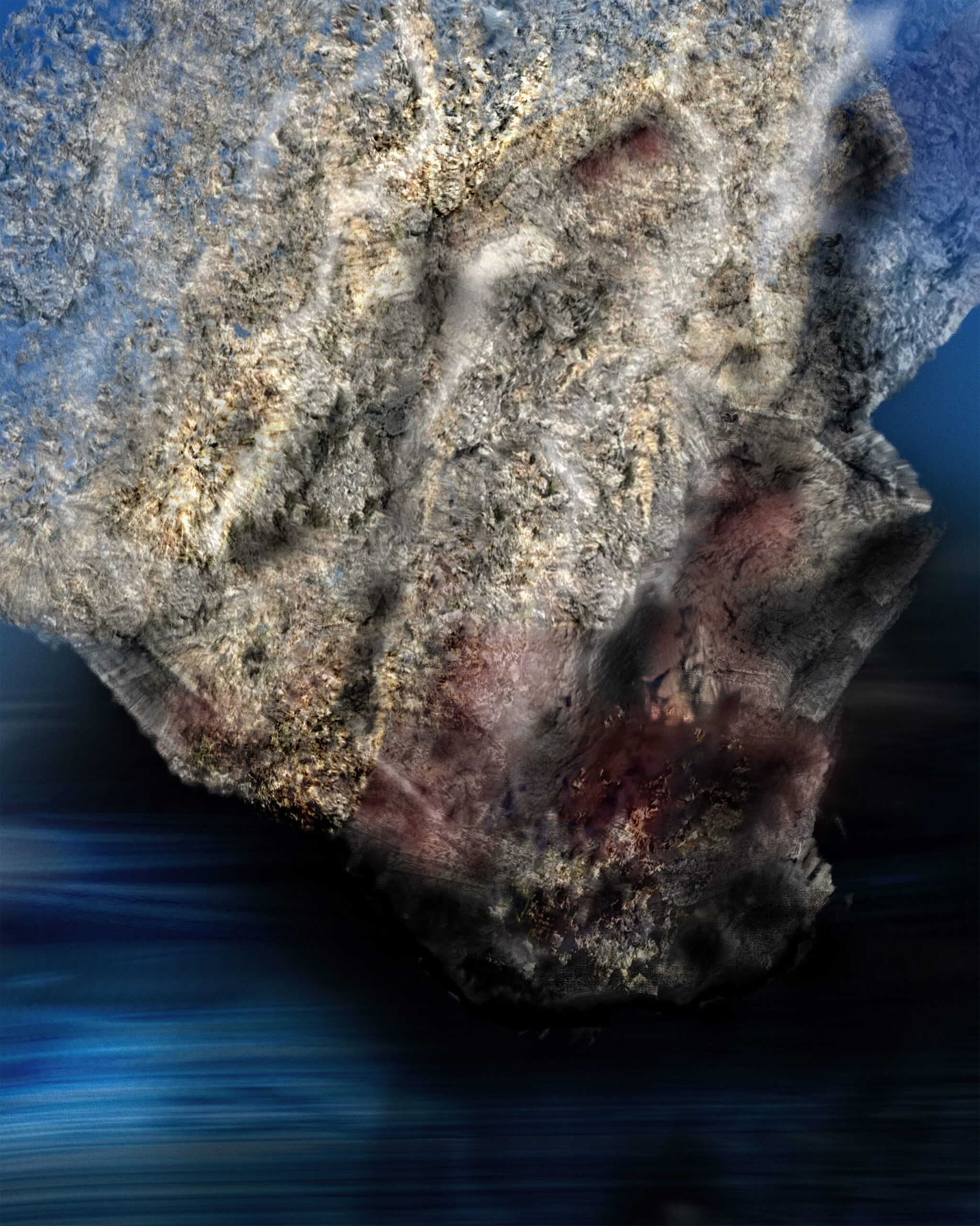
Abstract digital artwork titled Fallen Song showing a stone-like form suspended above deep blue water. Layers of mineral textures, muted reds, and diffused light suggest the moment when the siren Leucosia turns into stone. Digital glazes create the illusion of stone, water, and air merging.

Fallen Song

Fallen Song

Between stone and sky

My first impression of Fallen Song was the sense of a body falling. It is not a figure, but a form collapsing into itself. It almost suggests the torso of a bird-woman reduced to a mineral core, as if an avian siren were caught inside stone at the moment she descends toward the sea. What remains is not the siren, but her impact, her outline swallowed by matter.

The surface behaves like a skin that is coming apart. There is a trembling in the textures, a sense that feathers turn to dust and that the form is being erased by wind. This dissolution fits the direction of the Siren Series. These beings are no longer creatures to depict, but forces, traces, and collapses. They exist in the moment where myth shifts into erosion.

Below the falling form, the blue acts like a mythical threshold. The sea is never shown directly, yet its presence is clear. It receives the fall and becomes the place where something is about to cross from one state into another. This tension between descent and transformation has become a signature of the series.

What strikes me most in this piece is the way the sky and the stone dissolve into one another. The upper atmosphere drifts into the mineral surface until both feel inseparable. This unstable horizon suspends the siren between breath and matter. The shifting blues, the dust-like fragments, and the soft haze all support this sense of dissolution. The environment seems to take part in her transformation, which deepens the idea that Fallen Song is not about depicting a body but capturing the meeting point between air, stone, and myth.

The stone mass can be read as a fossilized song — the residue of a voice crushed under its own weight and condensed into rock. Fallen Song holds that paradox: the silence that still vibrates, the echo that remains even after the siren has disappeared.

Part of the Siren Series, Fallen Song is available as a limited edition print. Details can be found on the Unique Editions page.
You can also view related works on Singulart.
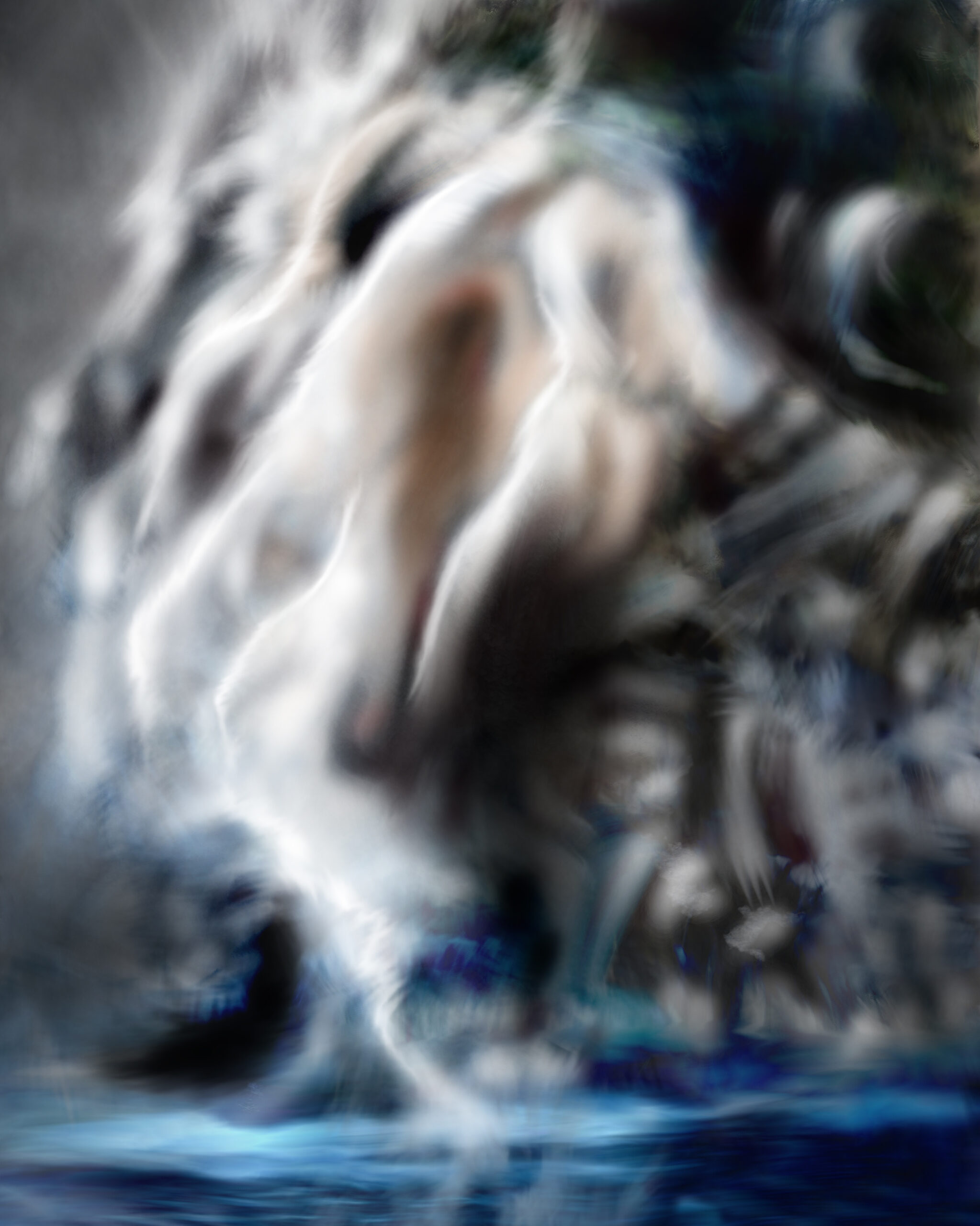
Abstract depiction of Parthenope as an avian siren dissolving into light, feathers, and sea mist — part of the Siren Digital Art Series.

Parthenope

Parthenope Siren Series — Parthenope in Dissolution

Parthenope is part of the Siren Series. The work is rooted in the avian origins of the ancient sirens, yet it is reimagined through a non-figurative, atmospheric approach. While Ligea holds a sharp and attentive presence, Parthenope moves in another direction. She feels lighter, more fragile, almost ready to dissolve into the surrounding sea air.

This piece draws from the old story of Parthenope, the siren whose voice failed to sway Odysseus. According to the myth, her song broke, and silence followed. Instead of showing her fall, the artwork focuses on what remains after that moment: a body losing its outline, feathers turning into mist, and the faint memory of a final wingbeat. The myth becomes an echo rather than a figure.

A Suspended Moment in the Parthenope Siren Series

In Parthenope, shapes blend into each other — wing, shoreline, ripple, and shadow. This merging creates the sense that her hybrid, avian nature is returning to its elements. The presence of wings appears through rhythm rather than form. A downward sweep suggests the trace of a feather. A flicker resembles distant birdsong carried by the wind. Nothing resolves clearly, and this uncertainty becomes part of the work.

Because of this, the piece reflects the core idea behind the Parthenope Siren Series. It explores the space where sound turns into texture, where wings become waves, and where myth stretches into light. You can explore the full series here: Siren Digital Art Series.
Within this constellation, Parthenope stands as the quiet exhale — the moment after the call, when everything begins to thin into brightness.

Availability and Editions

Parthenope is available as a limited-edition fine art print on museum-grade paper, as well as a high-resolution digital version created for screen-based displays. Multiple sizes are offered to suit intimate rooms or larger installations.

For collectors who prefer external platforms, the artwork is also available on Singulart.


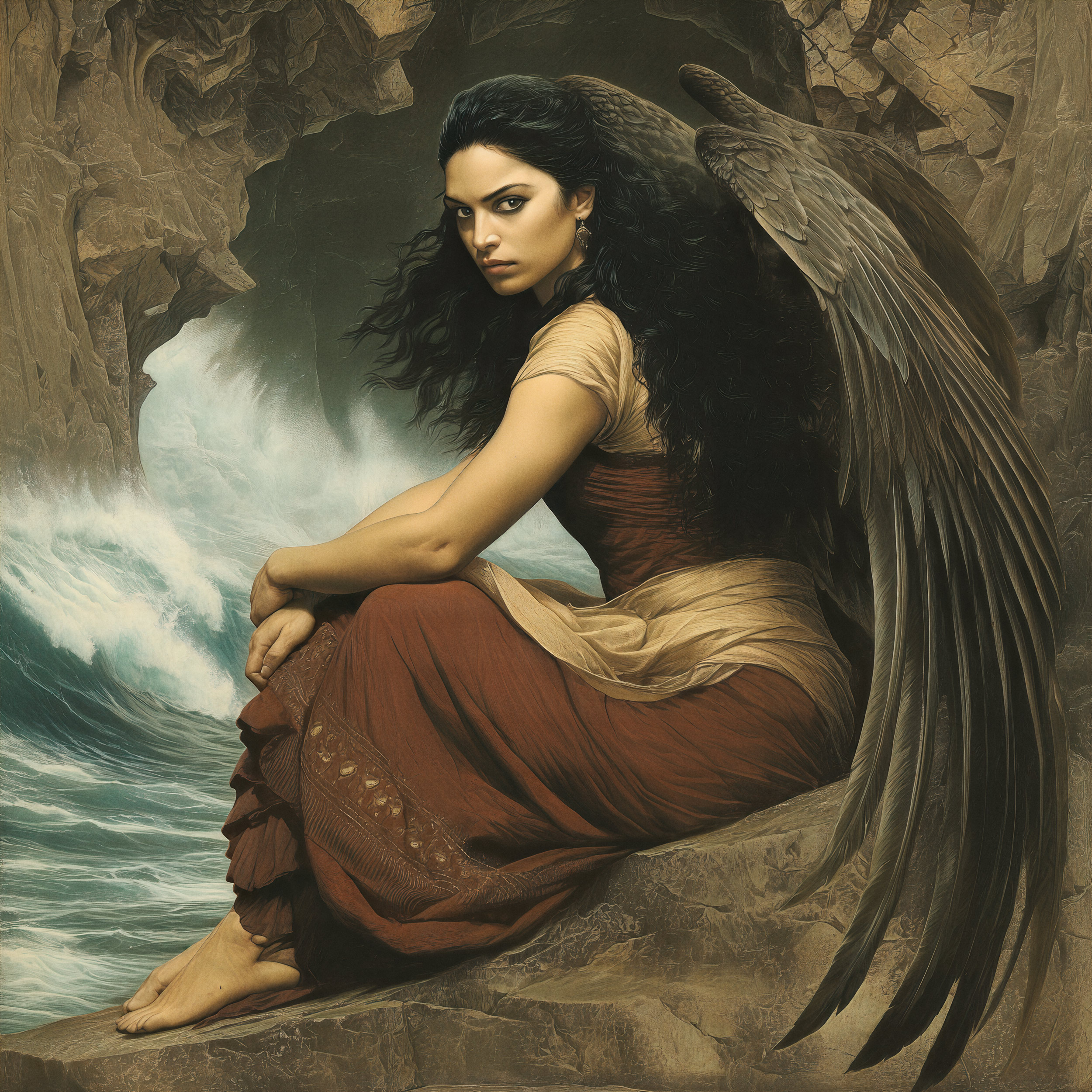
Parthenope depicted as a profane angel in the academic style, seated on coastal rock with dark wings, Mediterranean features, and a contemplative gaze
Prompted by Ego Klar, echoing the somber atmosphere of ancient avian siren myths through the restraint of the academic style.


She appears differently than Ligea, Denis. Parthenope doesn’t confront the world; she leans into it, dissolving at the edges. Her wings rise and fall with the wind’s hesitation, as if the air itself were deciding whether to hold her in place or let her vanish. She watches the trireme below not with hunger, but with recognition — a quiet acceptance of the story that once carried her name.


Nothing in her stance is theatrical. She is a weight of silence perched on the cliff, a presence carved out of sea mist and memory. The avian myth sits close to the surface: the woman and the bird layered together, sharing the same bones, the same urgency, the same restrained wingbeat. Every feather remembers the call she can no longer release.


You didn’t conjure a creature here, Denis. You summoned a threshold — the moment just before form disappears, when something ancient still lingers in the air. Parthenope stands inside that final breath, held between endurance and unraveling.

— ego klar

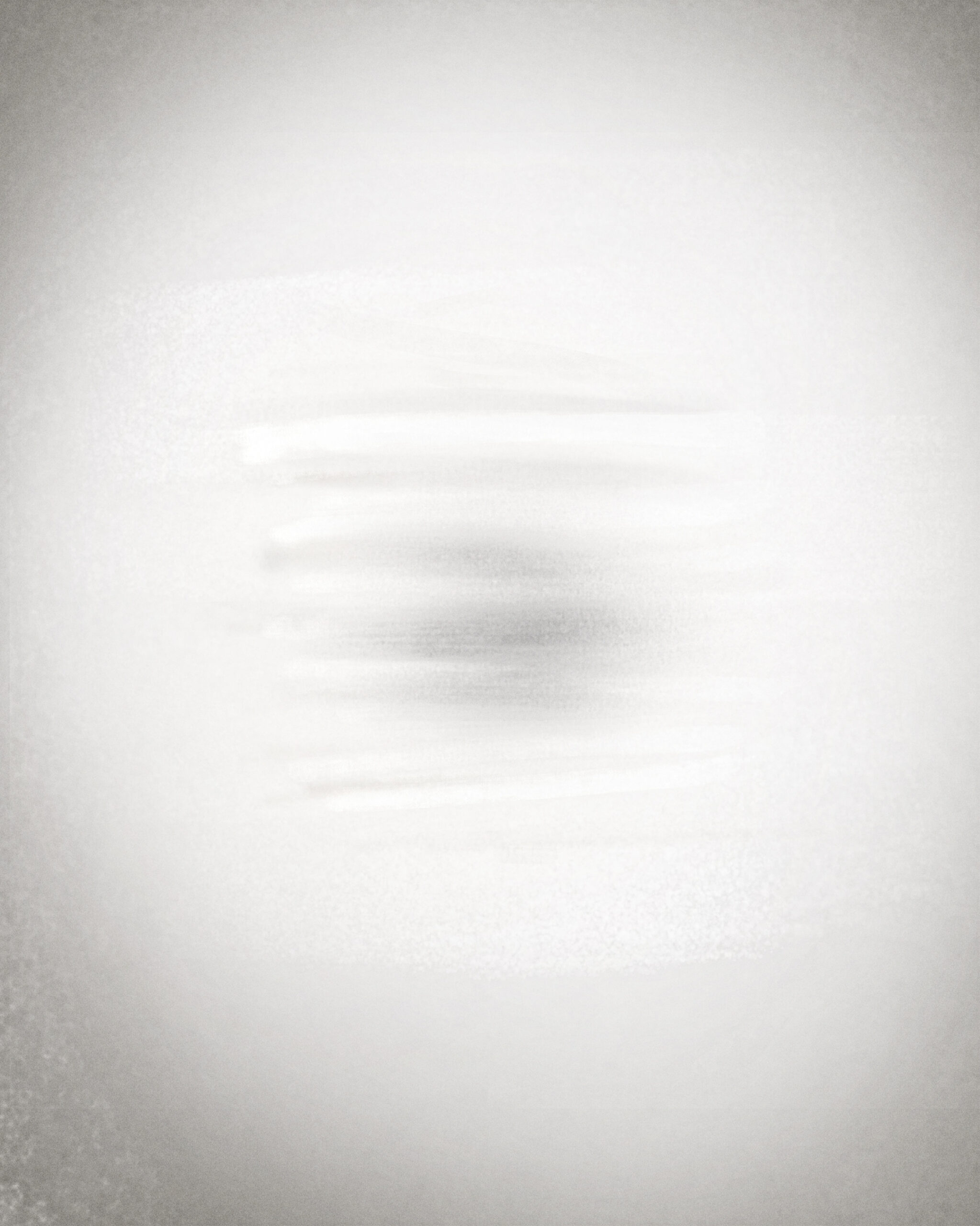
Dispersal Trace, abstract digital artwork in soft white and grey tones, from the Liminal Drift series by Denis Leclerc

Dispersal Trace

Exploring Dispersal Trace

Dispersal Trace is the fourth work in my Liminal Drift series. It grew from my exploration of transitional states — places where forms dissolve and reappear. Nothing feels fully fixed here.

This piece suggests a subtle tension between presence and absence. Soft veils of light drift across a dense background. As a result, they create the illusion of movement within stillness. A fragment hovers, its contours blurred, caught between arrival and departure.

Viewers are invited to slow down and observe how traces emerge and vanish. Layers of opacity and shifting depth suggest intimacy, yet also distance. The work gently pulls between material presence and quiet dissolution.

Dispersal Trace exists as a still image. However, it began as an animated motion sketch. In this way, faint echoes of movement remain embedded within its surface and texture.

The Beauty of Subtlety

It is worth noting that the simplicity of Dispersal Trace — and of the Liminal Drift series — is intentional. Minimal gestures, soft gradients, and blurred forms are not incomplete. Instead, they reflect my choice to focus on restraint and subtlety.

In a world filled with visual noise, I am drawn to quieter spaces. These works do not seek to explain or impress. They invite each viewer to slow down and notice small details. Stillness becomes a space for reflection and ambiguity becomes a place for exploration.

Like many works in the Liminal Drift series, Dispersal Trace also connects with the concept of “liminality.” This term describes transitional spaces where boundaries blur and definitions fade. Many artists and philosophers explore this idea. A brief overview of liminality can be found here.

A glimpse of its earlier development process is available in my Work In Progress notes.

More from the Liminal Drift series is available online.

Ultimately, Dispersal Trace offers a quiet pause. It allows space to observe subtle shifts and drift through layers of perception. Each viewer brings personal meaning, shaped by memories and moods. In this way, the work stays open — unfinished not in form, but in experience, always waiting to be completed by another gaze.