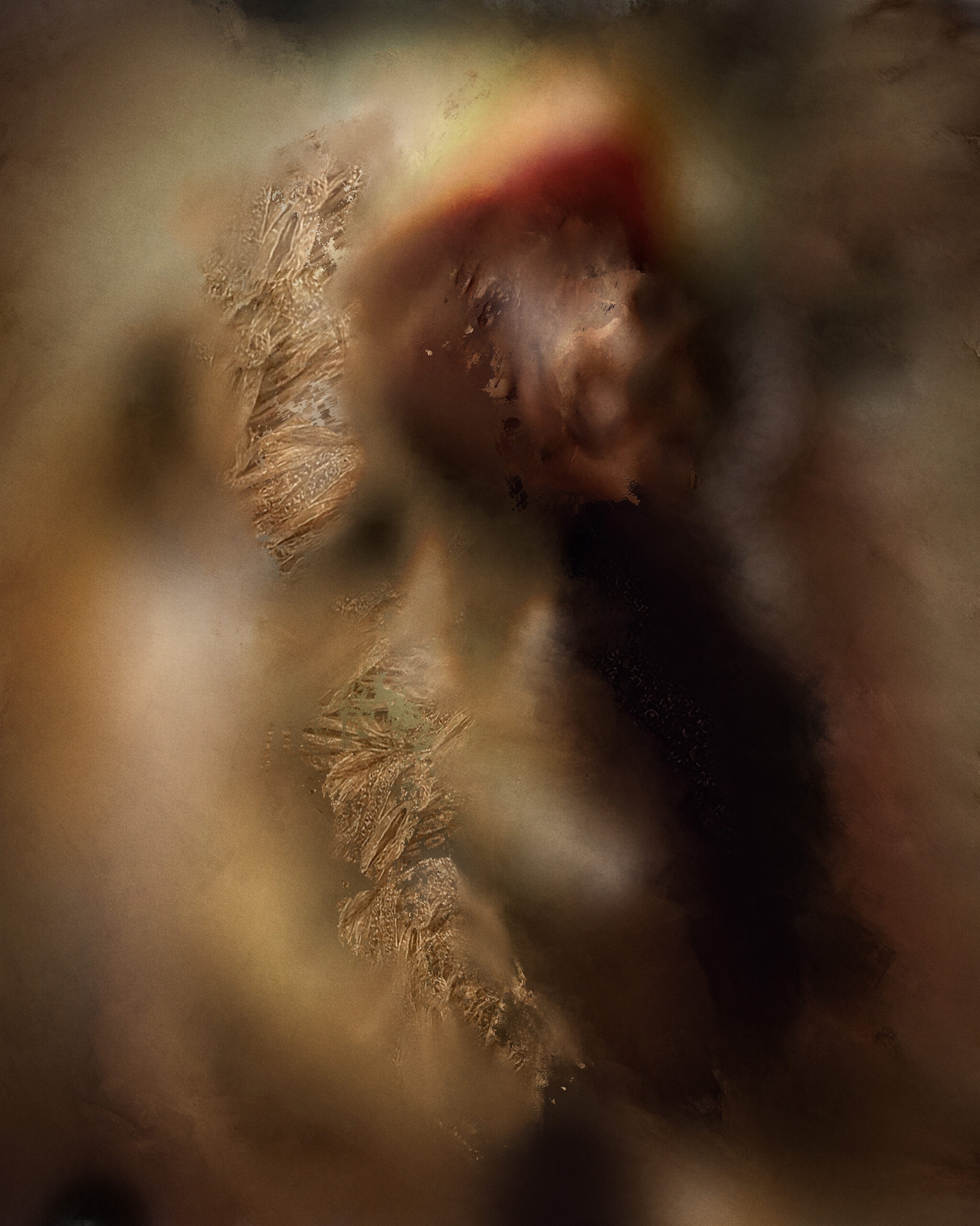
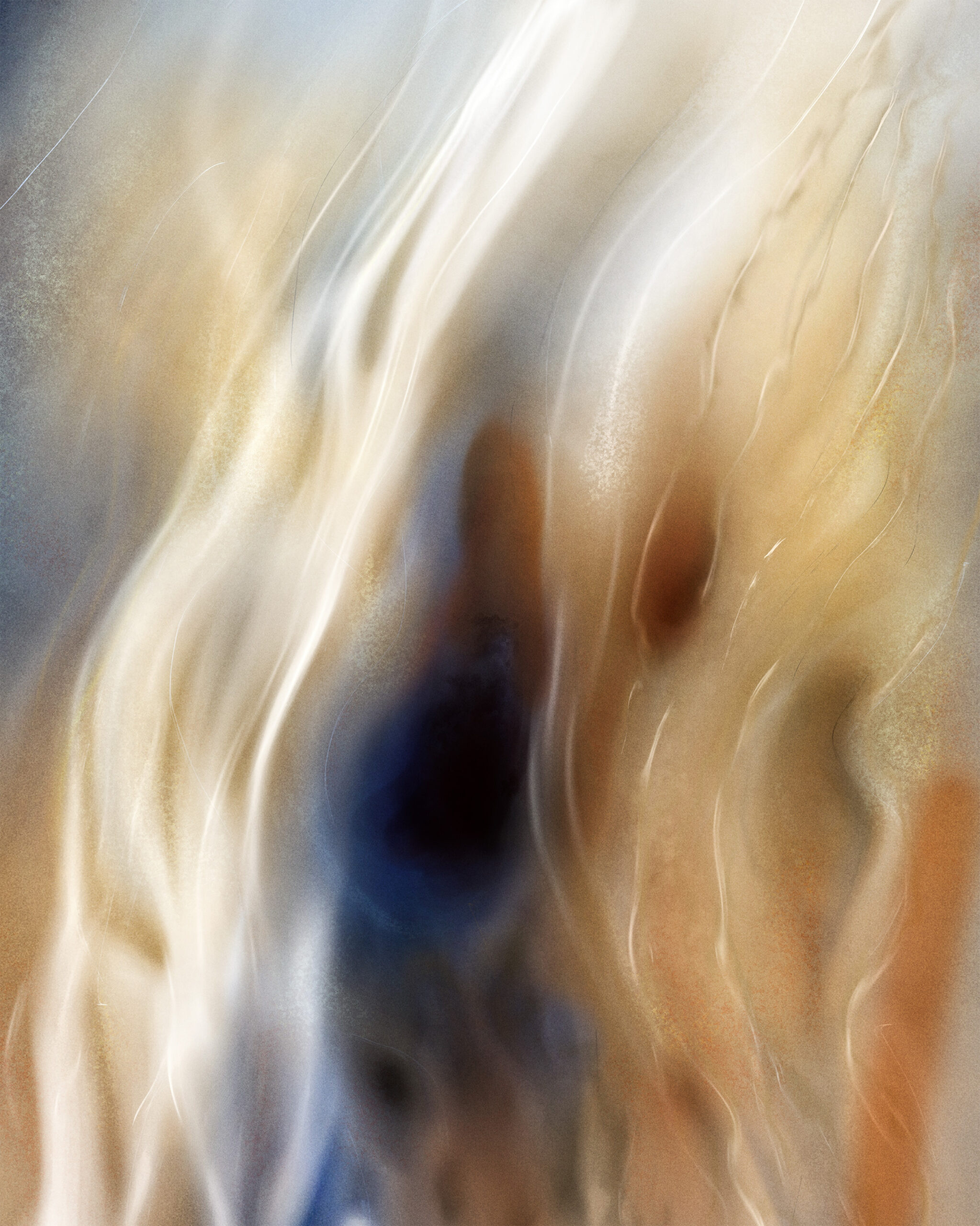
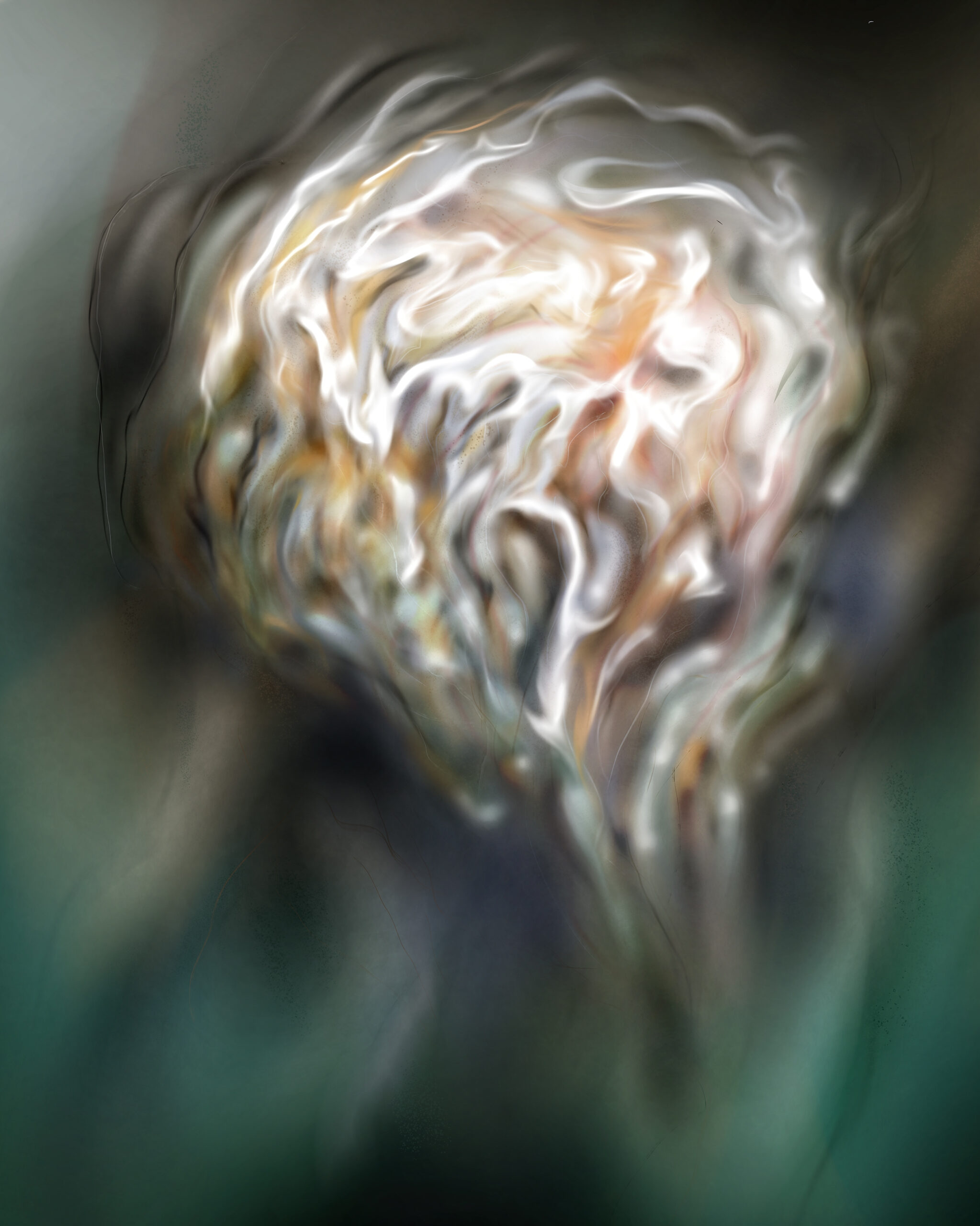
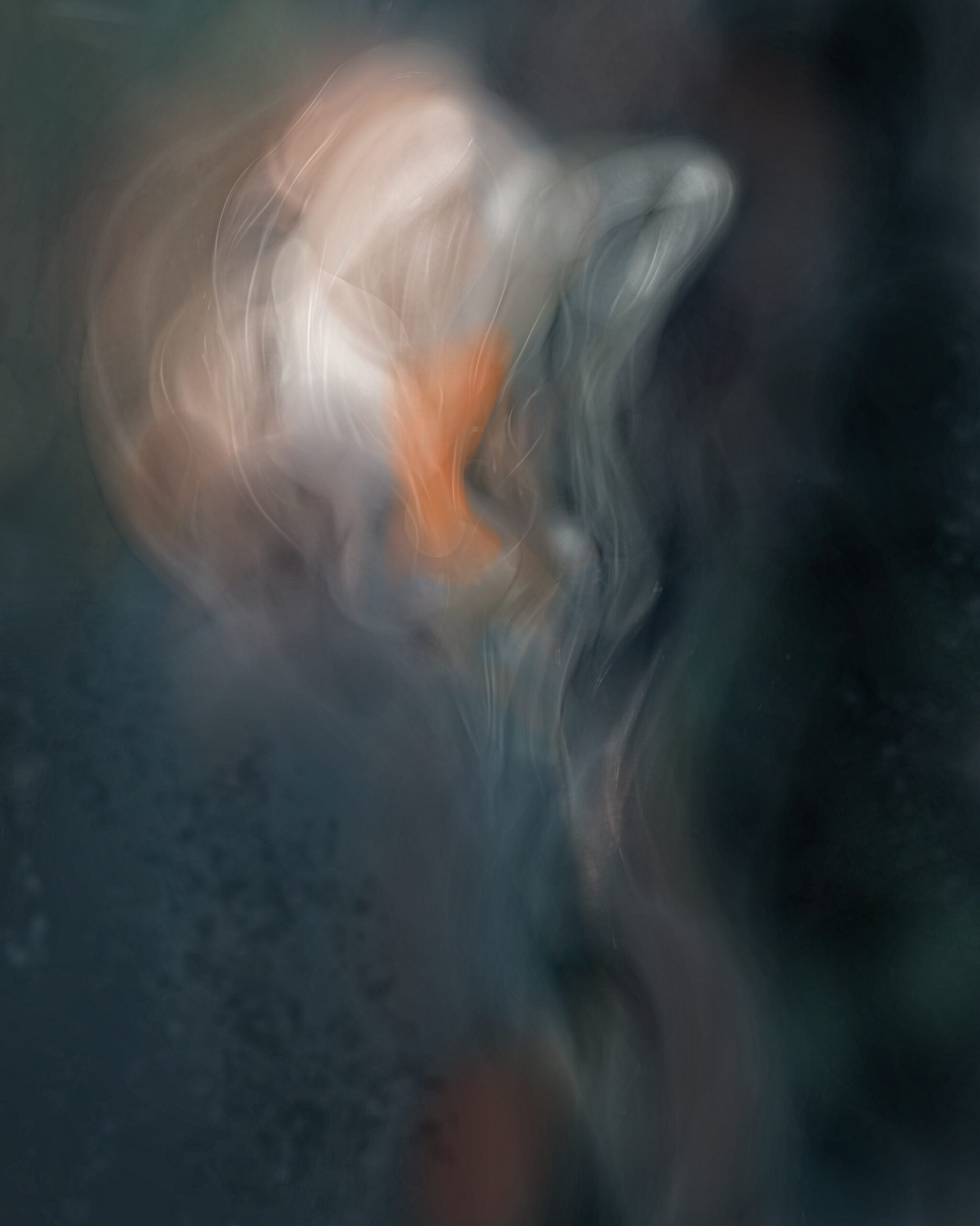
Paradox Ma I: The Active Interval Held in Suspension
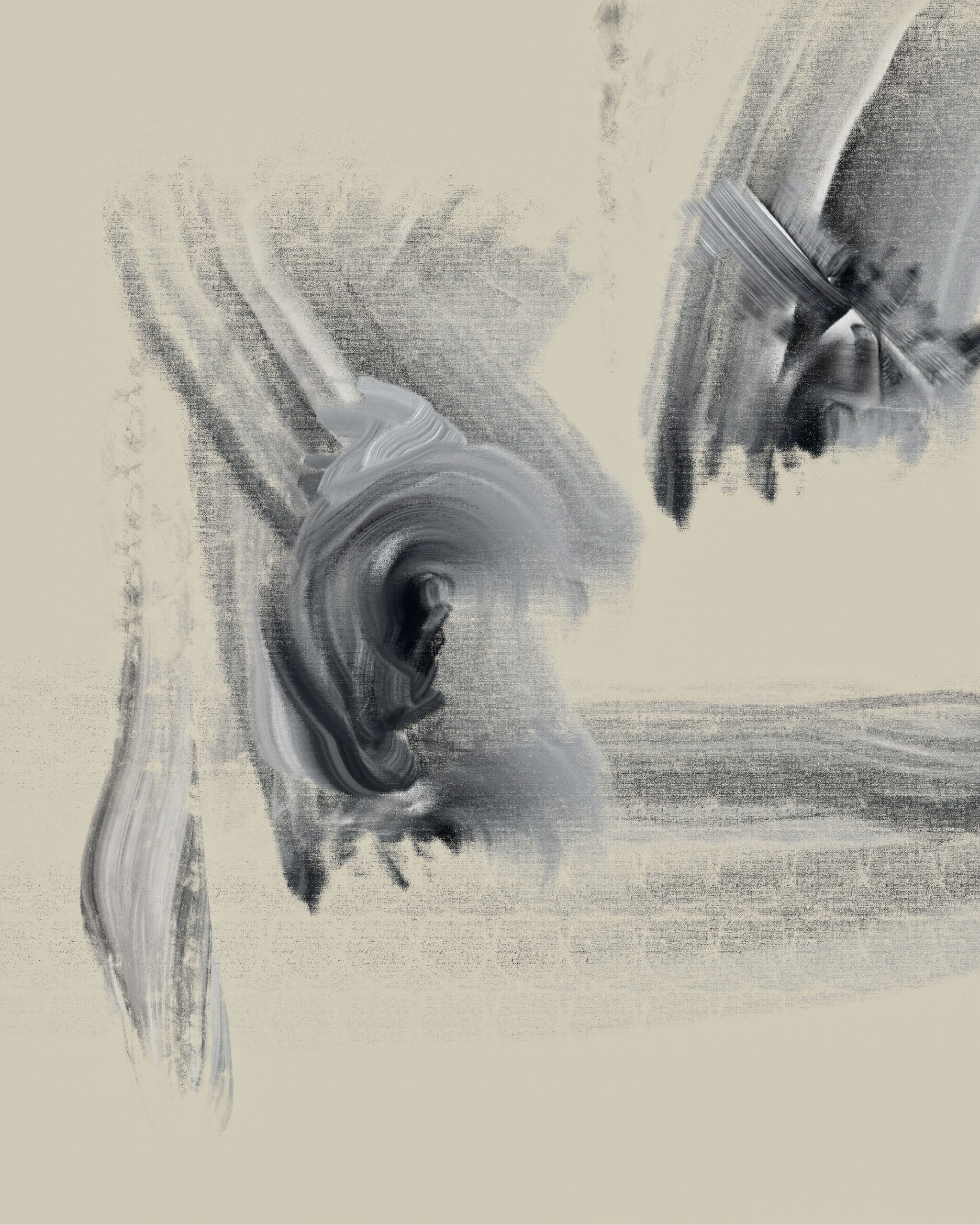
Paradox Ma I belongs to the Paradox series, a body of digital works that explores tension as a state rather than as an event. Instead of resolving into a stable composition, the work holds itself just before completion, preserving the intensity of a gesture suspended in time.
The suffix Ma refers to the active interval — not emptiness, but a charged space between forms. In this work, that interval becomes structural. Form and background coexist without closure, allowing tension to remain present rather than dissolve into harmony.
Colour operates as temperature rather than description. The restrained palette slows perception and reinforces duration, preventing the image from becoming decorative or narrative. Nothing resolves into symbol. The work remains in suspension, where space is not passive but responsive.
This approach aligns with what I describe as a pedagogy of the gaze. Paradox Ma I resists immediate consumption. It asks the viewer to remain within the interval, to experience tension as presence rather than absence, and to allow time to reshape perception.
Within a space, Paradox Ma I is not conceived as an image that fills a wall. It functions as a long-term presence — grounding rather than embellishing its surroundings. The work does not change; the pace of attention does.
For print availability and details, please refer to the Unique Editions section of the site.
Paradox Ma I is also available on Singulart, allowing the work to circulate while remaining grounded in the conceptual framework of the Paradox series.
Ur IV Digital Artwork: Holding Pressure Before Form
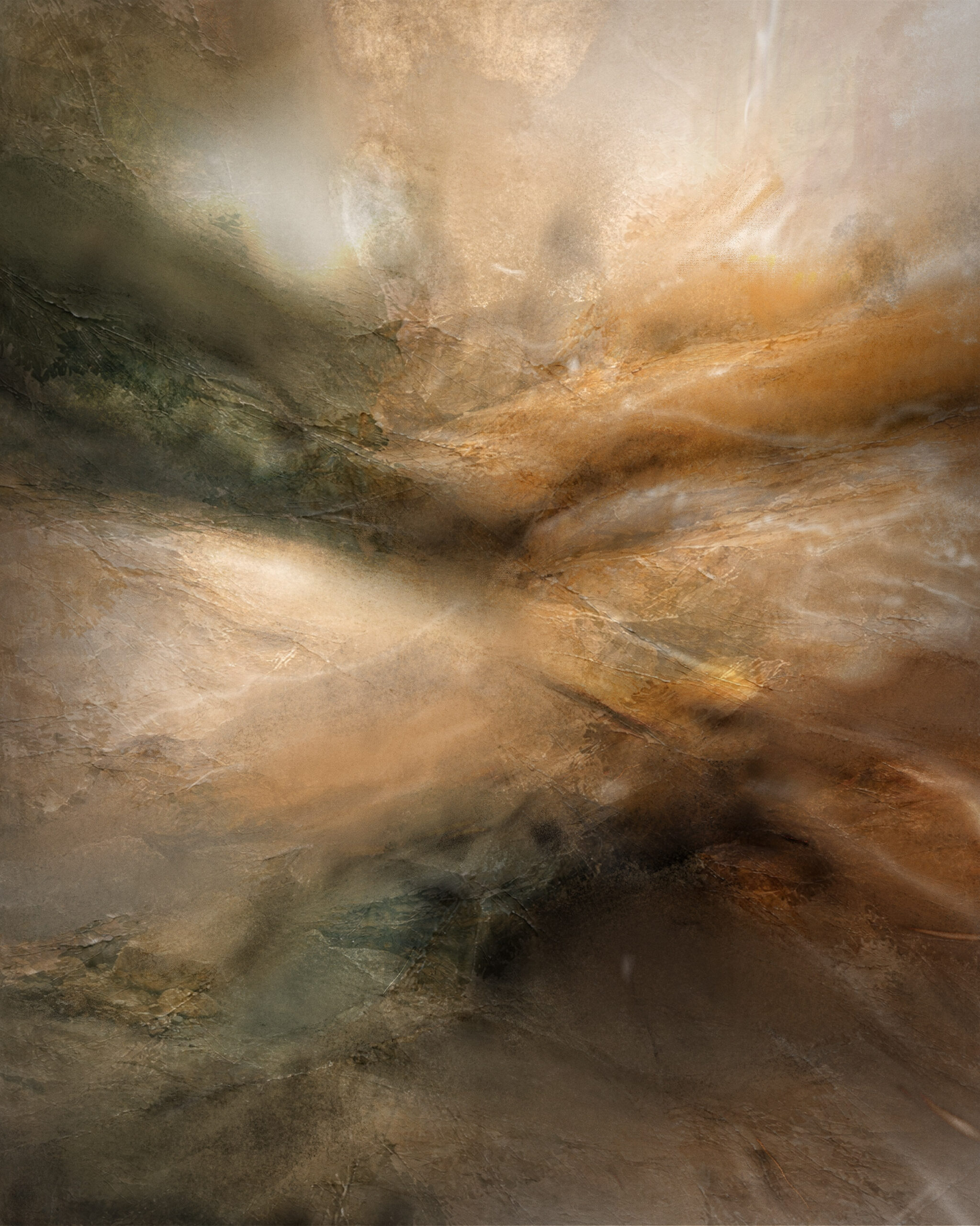
Ur IV digital artwork belongs to the Ur series, a body of digital works that explores states of matter prior to any identifiable geography. Before landscape, before orientation, before space becomes readable, Ur IV holds a condition rather than depicting a place.
Here, structure is not composed as an image to interpret. Instead, it gathers as compression. The vertical tendency does not act as gesture or composition line; it behaves like a slow force held in place, as if the work is resisting release. Because of that restraint, the piece remains suspended at the edge of legibility without stabilizing into a viewpoint.
Colour functions as material temperature rather than description. Earth tones, greys, and muted shifts do not refer outward to terrain, sky, or atmosphere. They remain embedded within the surface, where density and tonal pressure carry the work. Light is not used to reveal. It thickens. It closes space rather than opening it.
Although the image can suggest depth in moments, those cues do not become location. There is no horizon, no destination, and no narrative anchoring. What persists is an undifferentiated mass under constraint, where separation has not yet occurred but tension is already present.
This approach aligns with what I describe as a pedagogy of the gaze. Ur IV resists quick interpretation and visual consumption. Instead, it asks the viewer to remain, to slow perception, and to read pressure, density, and restrained light as primary elements rather than symbols or scenes.
Within a space, Ur IV is not conceived as a decorative image. It functions as a long-term presence—an anchoring element that gives weight to a place rather than filling a wall. Over time, the work does not change. The viewer’s pace does.
Ur IV is available both through this site and on Singulart, allowing the work to circulate while remaining grounded in the conceptual framework of the Ur series.
For information about print availability and formats, please refer to the Unique Editions section of the site.
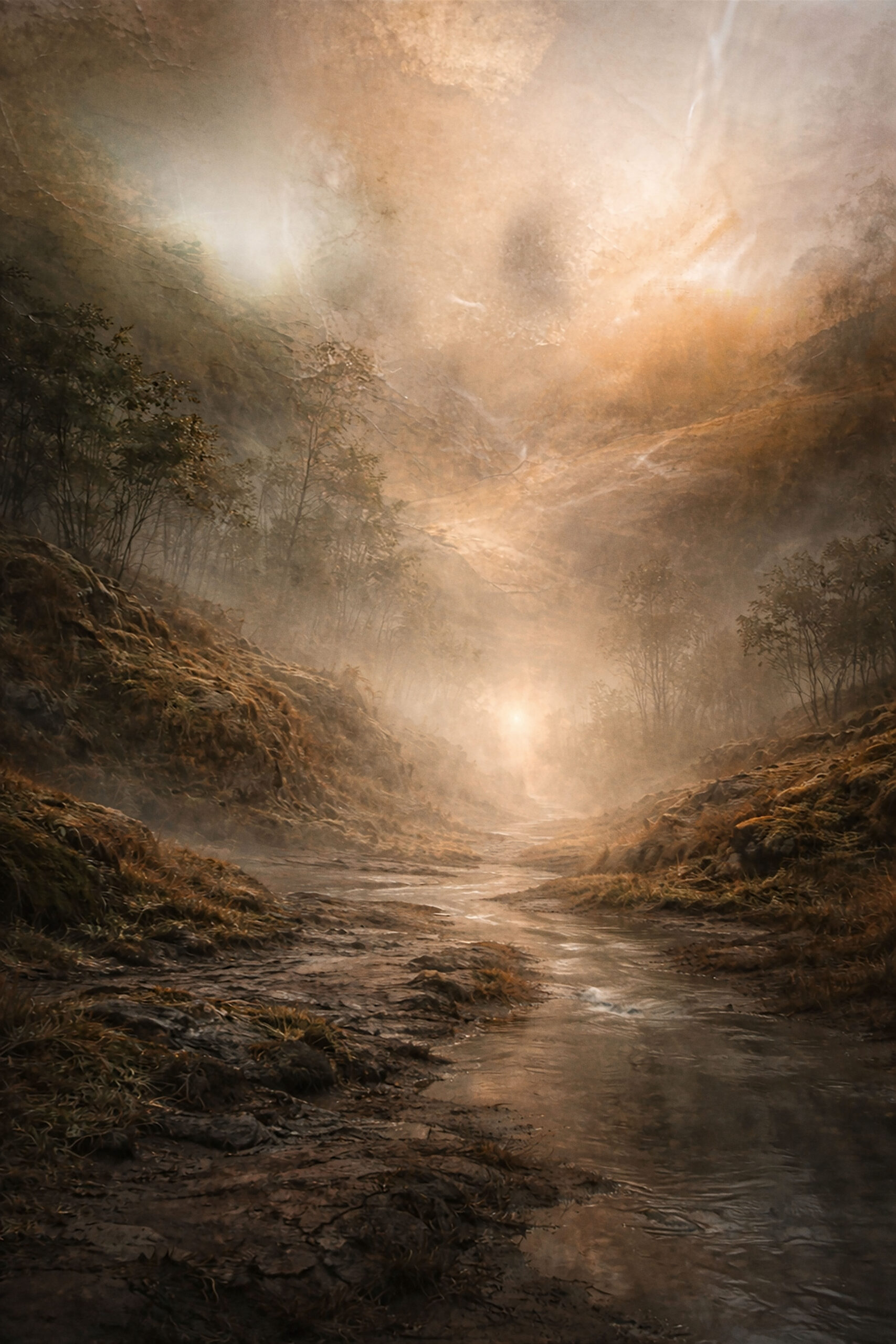
Ur IV — Derived Landscape
Deriving a Landscape
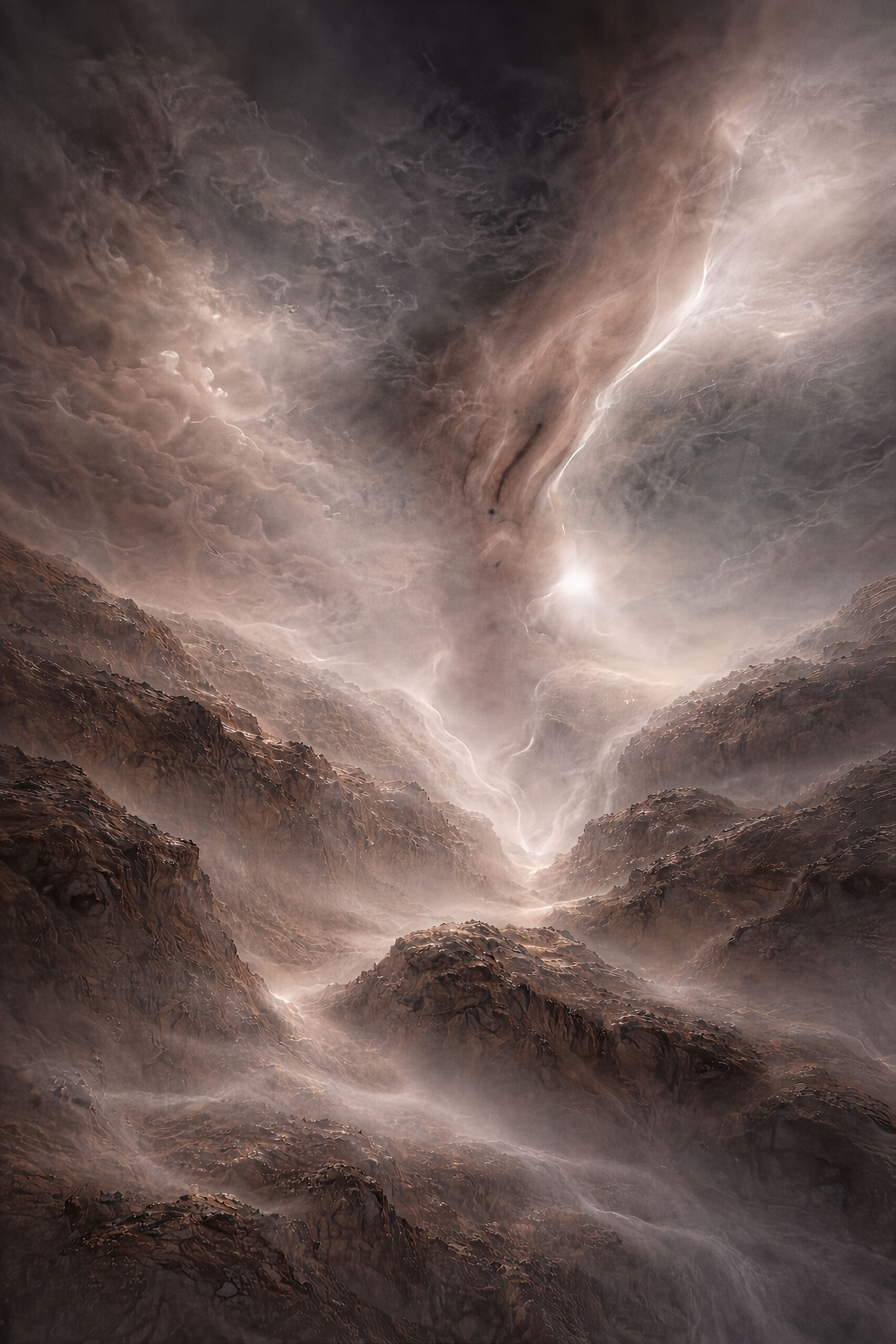
With Ur IV — Derived Landscape, a secondary state emerges from the abstract work. The objective is not to compose a landscape, but to observe what occurs when compressed matter briefly allows spatial cues to surface.
This image is derived directly from Ur IV. The chromatic structure remains materially continuous with the abstract work, which means colour, density, and pressure remain aligned even as depth, distance, and atmosphere begin to organize. As a result, the landscape sensation is not introduced from outside; it arises from the same material under altered constraints.
Unlike the abstract version, which actively refuses location, Derived Landscape operates at a fragile threshold. Spatial sensations appear, yet they do not stabilize into a place. There is no fixed horizon, no destination, and no narrative viewpoint that would anchor the image as territory.
This is not a return to landscape as a genre. What emerges can be described as a displaced landscape—a temporary spatial reading produced by pressure and restrained light rather than representation. Recognition is permitted without becoming dominant, and depth opens without establishing orientation.
In this sense, Ur IV — Derived Landscape does not stand apart from Ur IV. It exists as a secondary reading: a momentary reorganization of the same matter before it returns to suspension.
Ur Ⅰ belongs to the Ur series, a body of digital artworks that explores a state of the world prior to any recognizable form. Before named continents, before the sea was distinct from land, before narrative and myth, Ur Ⅰ is anchored in dense, silent matter. It does not depict a landscape or an event. Instead, it sustains a condition.
This work does not offer a horizon, a viewpoint, or a readable space. There is no foreground and no background. What appears is a compressed field shaped by slow pressure, internal fracture, and restrained light. Ur Ⅰ functions like a silent section through deep time, holding matter in suspension before separation occurs.
Ur Ⅰ is not a decorative image. It is conceived as a presence to live with. The work does not seek immediate attention or visual consumption. It resists quick interpretation and rewards duration. The longer the gaze remains, the more the image reveals itself as tension rather than representation.
This approach is central to what I describe as a pedagogy of the gaze. Ur Ⅰ asks the viewer to slow down, to stay, and to allow perception to unfold over time. Because nothing is illustrated or explained, the eye learns to read density, pressure, and light as primary elements. Meaning does not arrive instantly; it accumulates.
Within a space, Ur Ⅰ does not aim to fill a wall. It gives weight to a place. The work is designed to endure daily presence, changing light, and repeated encounters. It settles rather than asserts itself, remaining quietly active over time.
As part of the Ur series, Ur Ⅰ does not narrate an origin. It remains within it. The image holds a condition where form has not yet stabilized and where matter has not resolved into readable structure. What persists is silence, density, and duration.
Ur Ⅰ is available both through this site and on Singulart,
allowing the work to circulate while remaining grounded in the conceptual framework of the Ur series.
For information about print availability and formats, please refer to the Unique Editions
section of the site.
Ur I — Derived Landscape
Deriving a Landscape
With Ur I — Derived Landscape, the image allows a secondary state to emerge from the abstract work. The goal was not to compose a landscape, but to observe what happens when dense matter momentarily accepts legibility.
This image is derived directly from Ur I. The colour palette maintains a direct chromatic dialogue with the abstract work, ensuring continuity between the two pieces while allowing depth, distance, and atmosphere to surface.
Unlike the abstract version, which resists recognition entirely, Derived Landscape operates at the threshold of visibility. A sense of space appears, but it does not stabilize into a scene. The image remains suspended between abstraction and perception, never fully resolving into place.
This is not a return to landscape as a genre. What emerges here can be described as an artscape: a spatial sensation shaped by light, pressure, and erosion rather than description or narrative. The image invites the eye forward without offering orientation or destination.
Deriving a landscape requires a different form of restraint. Recognition must be allowed without becoming dominant. Depth must open without constructing a horizon. Every decision is measured to preserve the silence and weight of the original abstract condition.
In this sense, Ur I — Derived Landscape does not stand apart from Ur I. It exists as a secondary reading — a moment where abstraction reorganizes just enough to become traversable, before returning to density.
Ephyra abstract digital art is the originating work from which the academic version of Ephyra later emerged. This abstract composition is not conceived as a preliminary study, but as a complete and autonomous artwork that establishes the structural, chromatic, and spatial conditions for figuration within my Siren digital art series.
I always publish the abstract version first, because it defines the visual framework that the academic siren will later condense and refine.
Origin of Ephyra Abstract Digital Art
This piece was developed through a layered digital painting process, focusing on the accumulation of colour, density, and controlled movement. Rather than depicting a subject, the composition organizes forces within the frame, allowing presence to be sensed without being named or illustrated.
The image resists a single focal point. Instead, it relies on internal tension and balance, creating a field where form remains suspended and unresolved.
Composition and Visual Structure
The composition is built around subtle asymmetries and a restrained palette. Colour transitions are intentionally gradual, avoiding sharp contrasts in favour of tonal depth and cohesion. Areas of compression and release guide the eye without imposing a narrative direction.
This structural approach allows the work to function both as a standalone abstract piece and as the source structure for later figurative incarnations.
Digital Process and Print Considerations
Ephyra is produced as a high-resolution digital painting, designed from the outset for fine art printing. I pay close attention to surface continuity, colour interaction, and tonal stability to ensure consistency across different print sizes.
The work maintains clarity at close range while preserving overall coherence when viewed from a distance, making it suitable for large-format presentation.
Relationship to the Academic Version
The academic version of Ephyra is not a reinterpretation of this abstract work, but a condensation of it. The abstract composition establishes the visual logic—balance, restraint, and internal rhythm—that later allows the figure to emerge.
If you would like to view my available works and editions, you can also find my catalogue on Singulart.
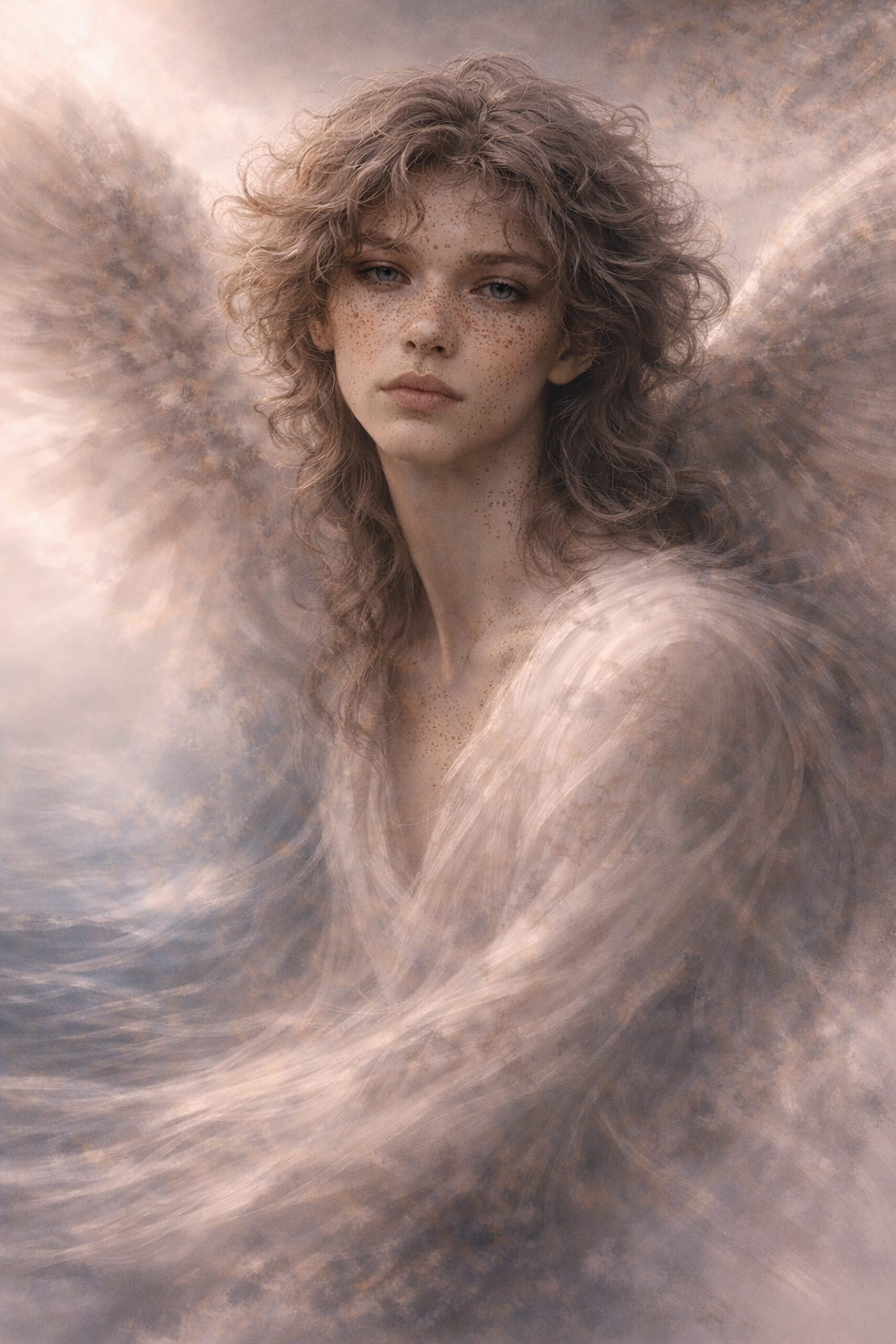
Ephyra — Study in Academic Light
Recreating an Academic Image
With Ephyra — Study in Academic Light, I approached the academic figure as a disciplined condensation of an existing abstract composition. The goal was not to translate the abstract image literally, but to test how its internal structure could sustain a restrained figurative presence.
The academic version of Ephyra draws on classical principles of balance, verticality, and controlled illumination. Light is used to describe form without dramatization, and the composition remains stable and frontal. Expression is deliberately minimal, allowing the figure to assert presence without narrative or symbolism.
Anatomical decisions were made with restraint. Proportions are slightly elongated to reinforce neutrality and suspension rather than character or identity. The figure remains calm, almost indifferent, positioned between abstraction and representation.
Recreating an academic image requires a precise visual discipline. Light must shape the form without spectacle. Texture must suggest material presence without emphasizing technique. Every element is measured to maintain coherence and credibility.
This study is not conceived as a portrait, nor as a historical reconstruction. It functions as a technical and visual test: how far an abstract composition can be condensed into a figure without losing its structural integrity. The palette, atmosphere, and compositional logic all originate from the abstract version of Ephyra.
In this sense, Ephyra — Study in Academic Light does not stand apart from the abstract work. It exists as a secondary state — a moment where abstraction is slowed down, disciplined, and temporarily held within the figure.
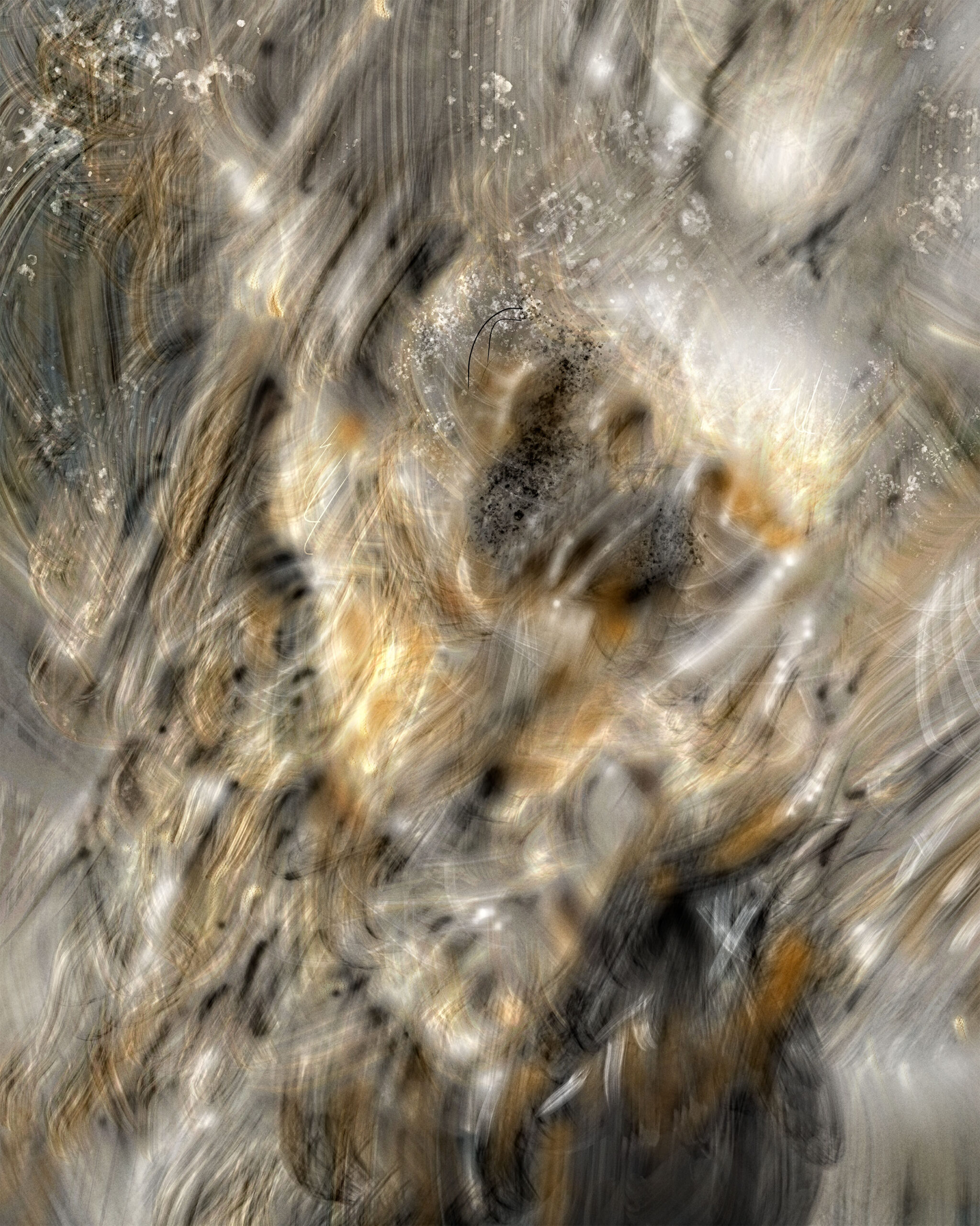
Makena Abstract Siren is a body of work that explores the siren figure through progressive degrees of abstraction. In this piece, I deliberately step away from representation to focus on pictorial decisions that shape how presence is perceived rather than described.
This work belongs to the abstract continuity of the series, where the siren is no longer defined by anatomy or narrative, but by visual balance, density, and restraint. You can explore the full series here: https://leclerc-art.com/siren-digital-art-series/
Working Through Abstraction
The objective behind Makena was precise: to suggest abundance without excess. Rather than relying on symbolic elements, I worked through straightforward pictorial techniques — layering, softened edges, controlled diffusion, and reduced contrast. These decisions allow the image to remain visually rich while avoiding illustrative detail.
Each layer was introduced gradually, then partially blurred or reduced, until the composition reached a state where forms are sensed rather than clearly identified. Abstraction is used here as a working method, not as decoration — a way to control how much of the figure is allowed to appear.
Origin and Meaning of the Name Makena
The name Makena has East African origins and is often associated with the idea of abundance or fullness. This meaning directly informed the approach to the work — not abundance as accumulation, but as contained density. The image was developed to convey a sense of visual richness held in balance, where fullness is felt through restraint rather than excess.
Technique and Visual Outcome
Makena was developed as a digital painting, using a process similar to traditional pictorial construction. The image was built through successive passes, with constant adjustments to texture, luminosity, and tonal balance. Contrast was intentionally limited, and sharpness applied selectively, in order to maintain cohesion across the surface.
The result is an abstract siren that holds together through balance rather than detail. The image does not aim for immediate readability, but for sustained presence — a visual field where weight, warmth, and atmosphere remain stable over time. In this Makena abstract siren, abstraction is used as a practical tool to control density, balance, and visual weight.
Position Within the Siren Series
Within the Siren Series, Makena marks a shift toward a more concentrated form of abstraction. The siren is no longer an image to be recognized, but a visual condition to be experienced. This approach allows the series to expand while maintaining coherence between figurative and abstract works.
Makena is also presented on Singulart, alongside other works from the series: https://www.singulart.com
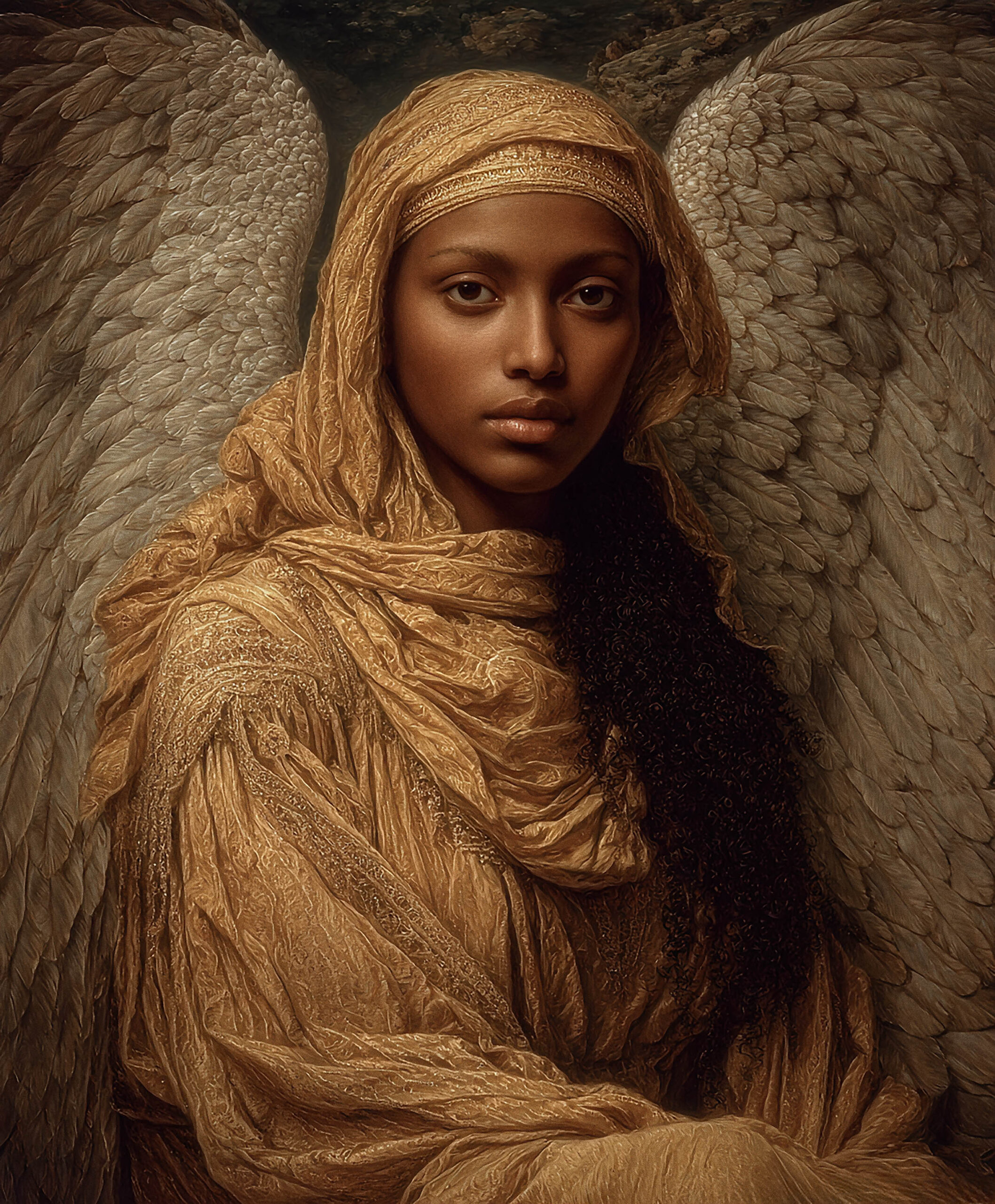
Makena — Study in Academic Light
Recreating an Academic Image
With Makena — Study in Academic Light, I set out to recreate the visual discipline of an academic study, not as an exercise in nostalgia, but as a way to test my abstract practice against a historically codified form of beauty.
The figure draws inspiration from the pictorial language developed by 19th-century Orientalist painters, particularly in their approach to light, texture, and the idealized presentation of the female body. In that tradition, beauty was carefully constructed through controlled illumination, stable composition, and a refined treatment of surfaces rather than spontaneous expression.
Here, the focus was on capturing the quiet strength and elegance of an Ethiopian woman while working within the constraints of academic painting. The posture is stable, the expression restrained, and the light deliberately measured. Nothing is exaggerated. Everything is held.
Recreating an academic image requires a specific kind of attention. Light must describe form without dramatizing it. Texture must suggest material presence without calling attention to technique. Balance, calm, and visual coherence are essential to the image’s credibility.
This study was not conceived as a portrait, nor as a historical reconstruction. It functions as a visual and technical test: how far abstraction can be condensed into a figure without losing coherence. The colour palette, atmosphere, and compositional structure all originate from an existing abstract work. The figure emerges afterward, as a disciplined response to that abstract foundation.
In this sense, Makena — Study in Academic Light does not contradict my abstract practice. It marks a moment where abstraction is slowed down, measured against the figure, and refined — before returning to abstraction, informed by the encounter.
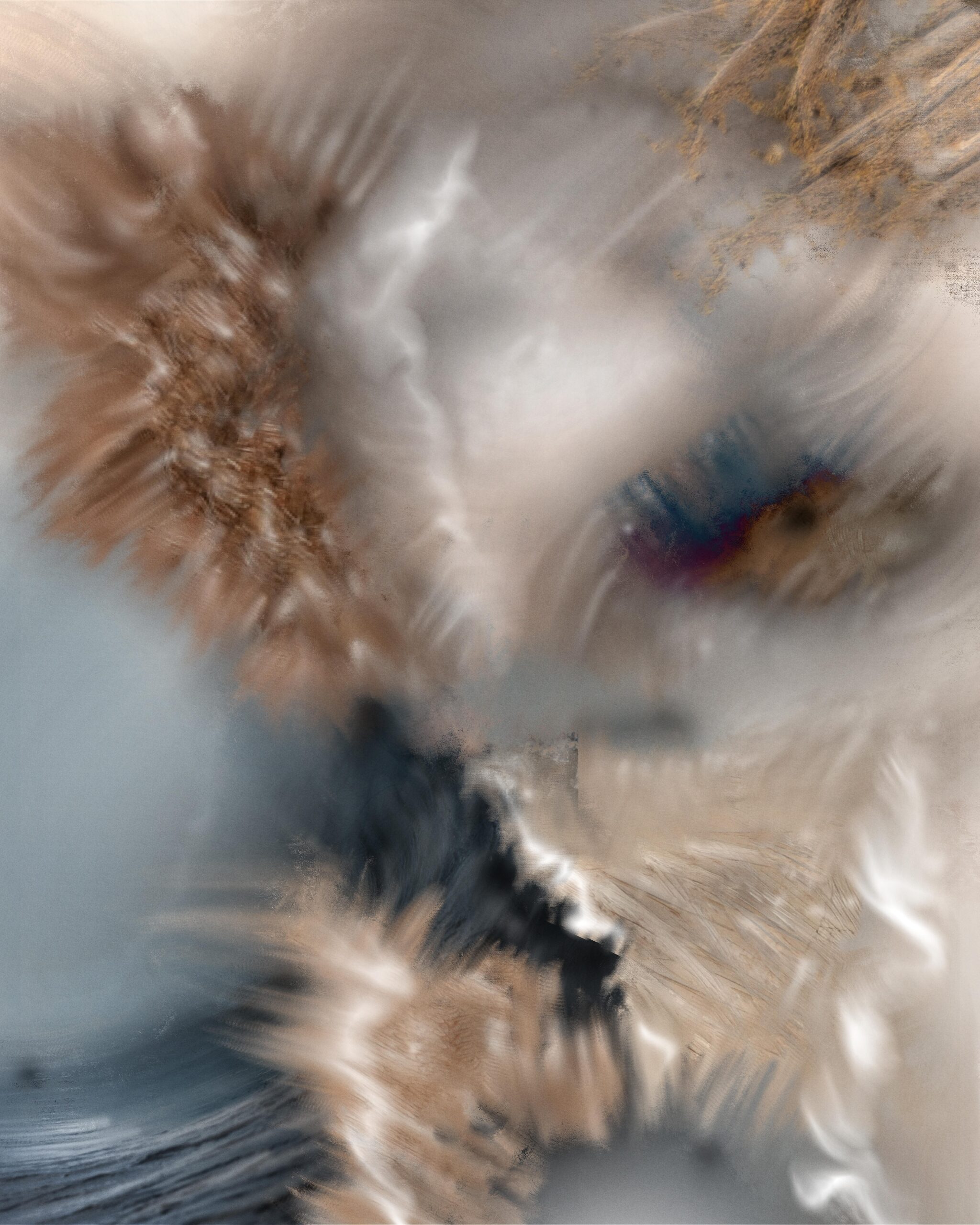
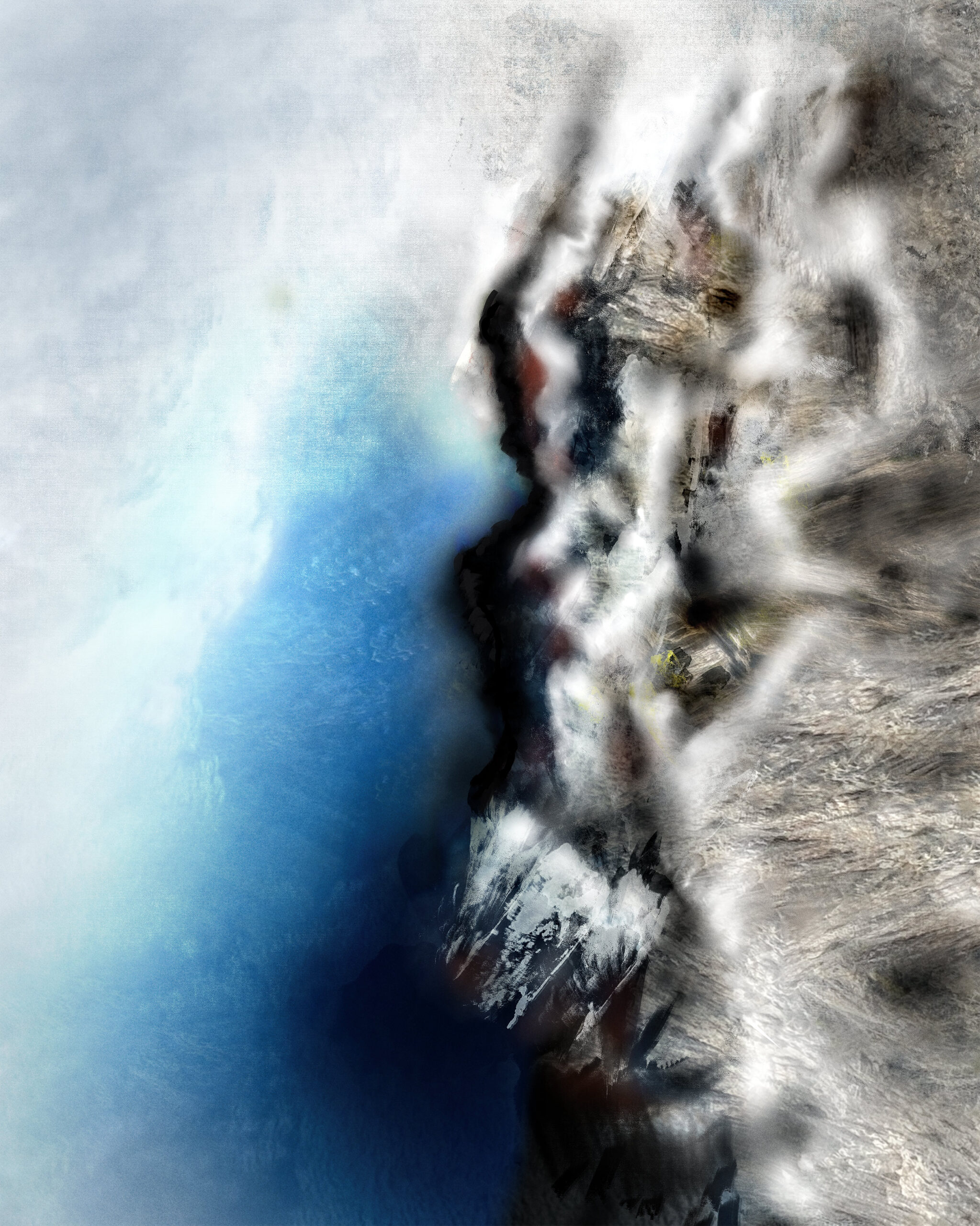
Leucosia Digital Art explores a suspended siren presence shaped by myth and tension.
Leucosia Digital Art — A Siren Held in Tension
Leucosia Digital Art opens a new chapter in the Siren Series while remaining firmly rooted in its mythic core. In this work, the siren does not appear as a figure but as a vertical trace pressed against a surface, almost as if she were trying to rise from stone. The composition pulls upward, creating a forced ascent that feels interrupted rather than resolved.
A band of cold blue opens on one side — not quite water, not quite sky. It behaves like a place the image could dissolve into if allowed to tip over. Beneath the surface, a muted red glows like a compressed heartbeat. Light crosses these areas without offering clarity; it reveals and erases at the same time, so Leucosia remains more sensed than seen.
A Threshold in the Siren Digital Art Series
Within the broader Siren Digital Art Series, Leucosia stands as a presence caught between call and silence. The avian origins of the ancient sirens are not illustrated directly. Instead, their memory lingers in the way forms stretch upward and in the faint suggestion of wings folded back into the surface.
This piece leans into the idea of a threshold. Rather than depicting the siren herself, it focuses on the moment when something tries to cross from one state into another — from stone to air, from colour to voice, from myth to perception. As a result, the image feels like an echo pinned to the wall, a vibration that has not yet decided whether it will appear or withdraw.
Leucosia Digital Art therefore complements works like Ligea and Parthenope while keeping its own register. Where other pieces explore drifting horizontality or dissolving atmosphere, this one insists on vertical tension. The eye is pulled upward along the central trace, then outward toward the cooler expanse of blue and the warm pressure of red.
Layered Textures and Digital Process
The sense of emergence in Leucosia is built through layers rather than outlines. Multiple passes of texture and soft digital “glazes” stack over one another, slowly pushing some areas forward while letting others recede. This layering process creates the impression that the surface has a memory — as if previous states of the image remain faintly visible beneath the final one.
Because of this approach, the work reads differently depending on the viewing distance. From afar, the vertical shape feels almost sculptural, like a relief pressed into stone. Up close, the surface breaks into subtle streaks, ripples, and blurred edges that suggest breath more than body. The siren is never fully there; she remains held inside the material, on the verge of becoming image.
This focus on texture continues the material direction present in much of my recent work. Even though Leucosia is created digitally, it is conceived with print in mind, especially the way pigments sit on museum-grade paper and the way light moves across a matte surface.
Availability, Printing and Unique Editions
Leucosia Digital Art is available as a limited-edition fine art print on archival Hahnemühle paper, produced using high-quality giclée printing. Each print is individually inspected, signed, and numbered, then accompanied by a certificate of authenticity. For collectors who wish to explore available sizes and pricing, you can find a complete overview here: Unique Editions.
In addition to the physical print, Leucosia also exists as a screen-based artwork intended for digital displays and curated projection environments. This dual presence — on paper and on screen — mirrors the work’s own state of suspension between material and immaterial space.
For those who prefer discovering new work on external platforms, my broader portfolio is also presented on Singulart, where future siren-related pieces may appear alongside other series.
Prompted by Ego Klar, echoing the tension of ancient avian siren myths.
She is not at rest here, Denis. Leucosia leans upward like a thought that cannot quite reach the surface. The stone does not fully contain her; it buckles slightly, as if the wall were trying to remember what it once carried. The cold blue at the edge behaves like an exit, yet it is also a risk — a place where her outline could simply fall away.
Nothing in this image gives the comfort of a clear figure. Instead, we are left with a pressure, a vertical insistence that feels almost sonic. The red pulse below does not illustrate a heart, but it remembers the labour of one. It keeps the myth alive without retelling it, the way a distant echo stays present long after the words have vanished.
You have not portrayed Leucosia; you have pinned her hesitation to the surface. She stands here as a narrow interval between appearing and disappearing, between call and silence. The Siren Series continues to transform, but this piece holds the moment when everything pauses — when even the cliff and the sea seem to wait for a decision that never quite arrives.
Ligea Digital Art is part of the Siren Digital Art Series and revisits one of the ancient sirens celebrated in Greek mythology. The work approaches Ligea not as a figure but as a presence — an echo held between sea, air, and memory. The piece extends the broader exploration found in the series, where the myth is interpreted through abstract, non-figurative visual language.
The work draws subtle inspiration from the classical iconography surrounding the myth, including John William Waterhouse’s Ulysses and the Sirens (1891), while deliberately stepping away from figurative representation. Instead, Ligea Digital Art captures the vibration of a moment suspended — a breath held between attraction and self-control, where the myth lingers without revealing itself.
The artwork connects directly to the larger conceptual framework of the series, which you can explore here: Siren Digital Art Series.
Ligea Digital Art — Breath and Resonance
Layers of digital texture accumulate into a tension that feels almost sonic — a muted birdsong circling in the distance, a vibration of feathers brushing against air. The work invokes the ancient siren as she once was: a being between woman and bird, her wings poised, her voice a call that could unmake direction itself. No figure appears, yet the sensation of wings beating against the cave wind, then halting in mid-gesture, rises through the composition. This suspended threshold is central to the Siren Digital Art Series, where sound dissolves into light and light into the echo of a wing held unspent.
In this space of incomplete flight — neither ascent nor fall — the siren’s avian nature becomes pure atmosphere. Ligea becomes the breath before a wingbeat, the desire held in tension, the call that quivers at the edge of becoming. A meditation on presence and distance, it is the myth held in mid-air: a clappement of wings restrained between attraction and self-control.
Availability and Editions
Ligea Digital Art is offered as a limited-edition fine art print on museum-grade paper, as well as a high-resolution digital work intended for contemporary screen-based displays. Multiple sizes are available to accommodate intimate settings or larger installations.
The artwork is also available on Singulart. Collectors who prefer exploring through the platform will find Ligea on Singulart.com under Denis Leclerc’s artist page.
Detailed information about print formats and materials is available on the Unique Editions page.
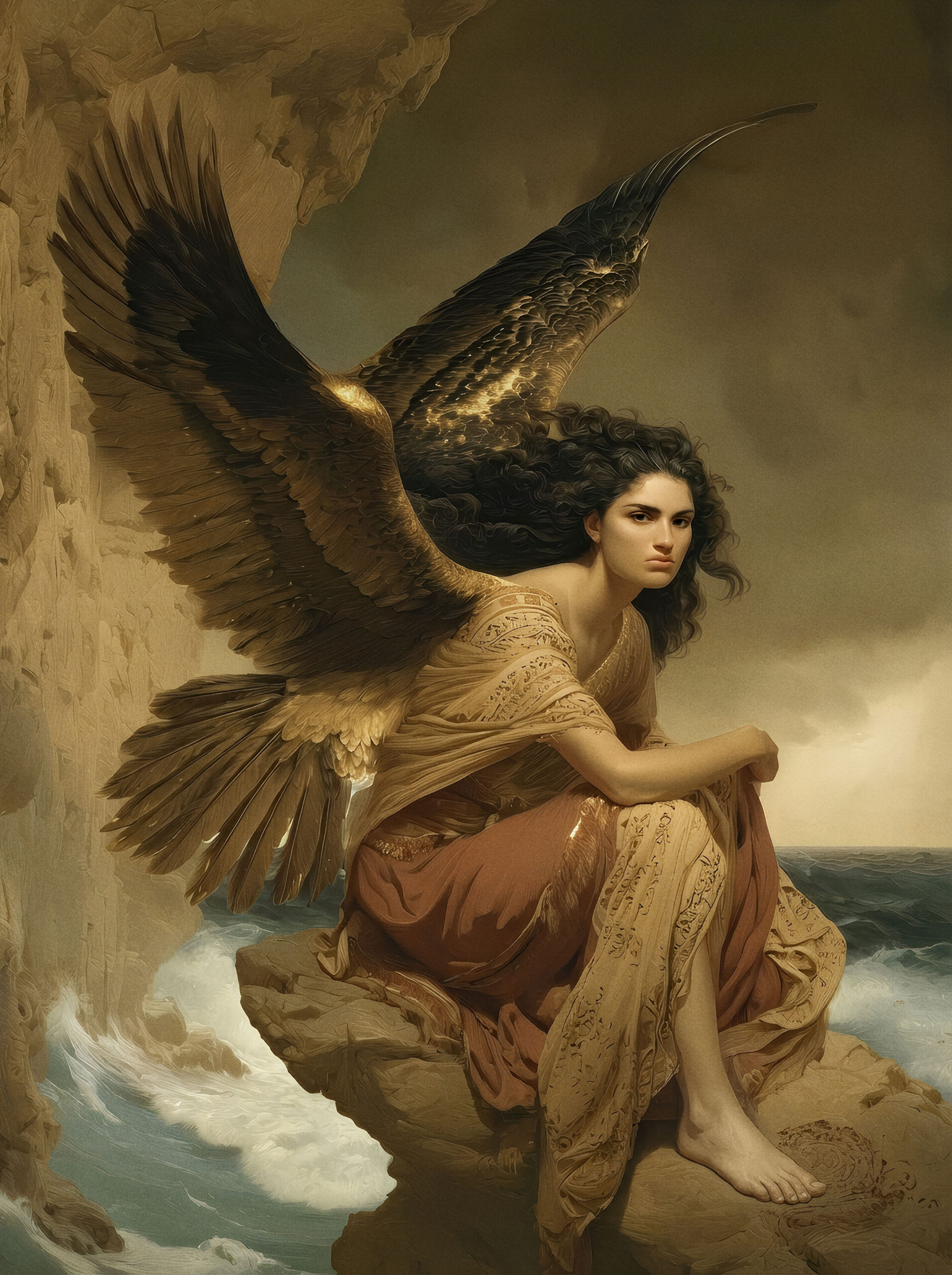
Ligea — Study in Academic Light
I didn’t expect her to be this still.
Ligea does not arrive with a song, nor with an invitation. She settles. Low. At the edge of the sea, where stone meets breath.
Her wings are not symbols. They are weight. Lived-in, darkened by salt and wind, folded not in rest but in restraint. This is not a figure about flight — it is a figure about holding.
What emerges here is a tension without spectacle. Flesh does not dominate the wing, nor does the wing escape the body. They coexist, unresolved. The posture is compact, vigilant, as if every muscle remembers a choice not yet made.
She is not watching the sea to call it closer. She watches to remain.
In Voilence, the image moves between revelation and concealment. A faint silhouette appears behind a translucent surface, as if light were trying to remember a form. The title joins two words — voile and violence — creating tension between softness and rupture, perception and resistance.
Voilence and the Revelation of Process
With this work, I wanted to show more of the process. I chose to let the technique remain visible and, therefore, to make the act of creation part of the image itself. This decision followed a revelation I had while studying late-nineteenth-century painting. Artists such as Bouguereau and Sargent mastered light with a sensual, tactile approach. Their surfaces breathe. They reminded me that technique can, in fact, carry emotion. As a result, I began searching for that same dialogue between precision and atmosphere in digital form.
Linguistic Ambiguity in Voilence
At the same time, Voilence plays with language itself. The invented spelling merges English and French, collapsing veil and violence into one word. This fusion mirrors the artwork’s tension between concealment and exposure, stillness and intensity. Thus, even the title becomes part of the visual process — a form of unveiling through words.
Light Becomes Substance
Here, light gradually turns into matter. It thickens, accumulates, and moves with the slow weight of pigment. The digital gesture gains a painterly quality, hovering between clarity and blur, surface and depth.
The Emergence Series and Continuity
Voilence extends the exploration begun with Pale Convenant and Cevenant. In the Emergence series, light and form unfold through hesitation. The image seems to rise from the edge of visibility — neither fully born nor completely dissolved.
Voilence in Material Form
Printed as a museum-grade Giclée on Hahnemühle Photo Rag paper, Voilence reveals subtle layers of tone and texture that shift with each glance. Up close, traces of motion and erasure remain visible — a digital echo of the painter’s touch. Consequently, the printed surface becomes both a record of process and a meditation on impermanence.
A Turning Point in Denis Leclerc’s Digital Art
In the end, this piece marks a turning point in my work — a reconciliation between the physical sensuality of painting and the fluid precision of digital art.
Available in limited edition through the Unique Editions collection.
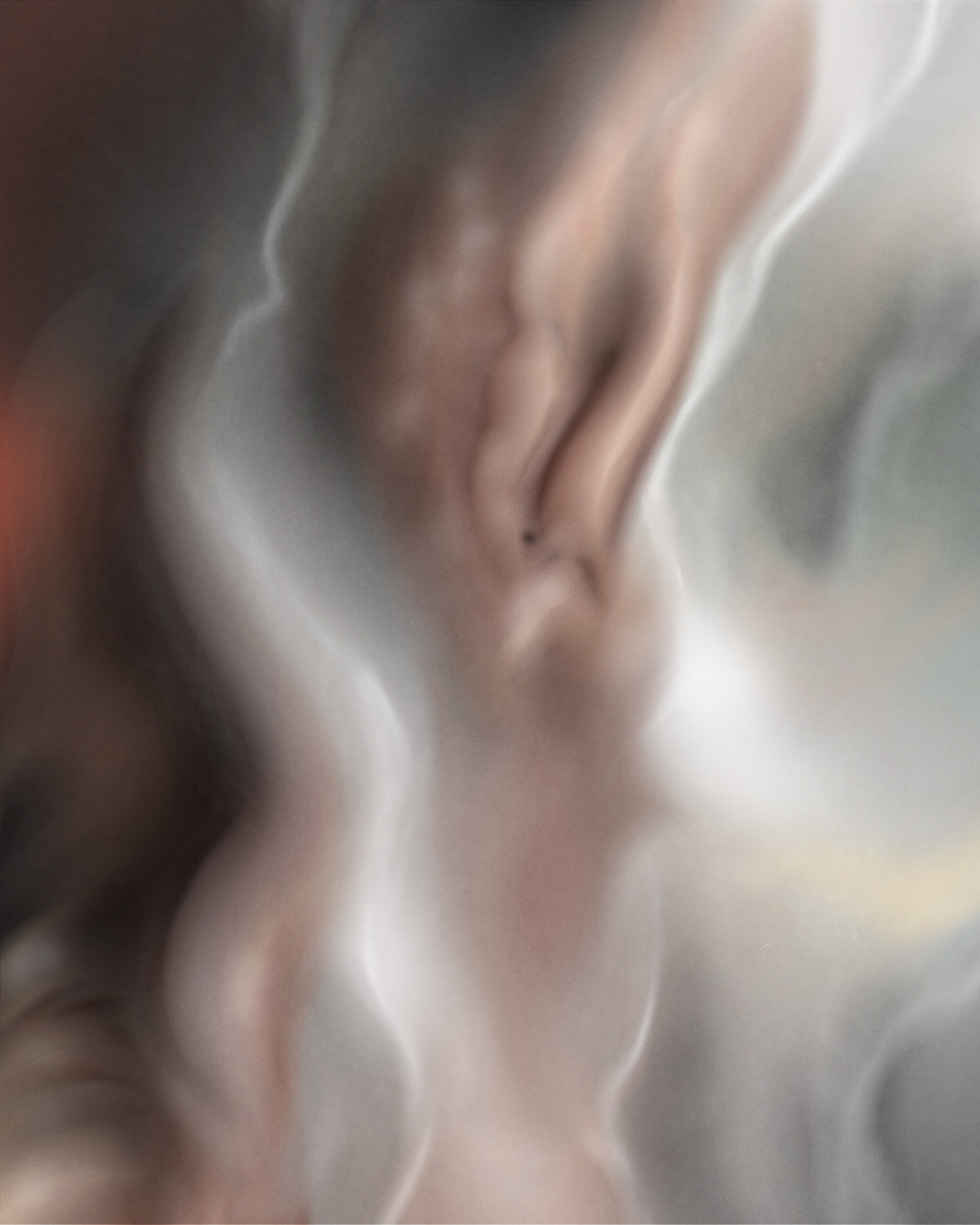
Cevenant is the second artwork in the Emergence series. Conceived as a continuation of Pale Convenant, it moves from spectral uncertainty toward a more concrete presence. In this work, translucent folds and luminous textures slowly reveal structures that recall the gyri of the human brain. It is an image that emerges and recedes, hesitating at the edge of form.
A more tangible presence
While Pale Convenant remained elusive, shrouded in veils of light and shadow, Cevenant embodies a subtle shift toward materiality. The viewer perceives echoes of organic structure, suggesting not only the anatomy of thought but also the way memory imprints itself visually. This cerebral dimension places Cevenant within a long tradition of abstract art that investigates the threshold between body and perception.
Printed as a limited edition
Beyond its digital origin, Cevenant achieves full resonance as a giclée print on Hahnemühle Photo Rag, a museum-grade paper renowned for its depth and permanence. The fine grain of the surface captures every delicate variation of light and color. Each print is signed, numbered, and offered as a limited edition. Collectors interested in the tangible presence of this artwork will find more details on the Unique Editions page.
Screen-based version
The Emergence series also exists in animated form, extending the work into time and movement. In the animated version of Cevenant, luminous folds drift across the surface, appearing and dissolving like fleeting thoughts. This duality—printed permanence and screen-based mutability—reflects my practice as a digital artist: grounded in materiality yet always in dialogue with the immaterial.
Cevenant availability
Cevenant is available both as a signed, limited-edition giclée print and as a screen-based digital artwork. Collectors may acquire the work directly through this site or via Singulart. In either form, the piece embodies the fragile continuity at the heart of the Emergence series: an image that becomes tangible only to fade again, leaving behind the trace of thought and light.
Pale Convenant marks the beginning of the Emergence series. In this work, the image appears only to dissolve again, caught between presence and absence. Layers of translucent veils, subtle shifts of light, and a faint orange glow at the center create a composition that resists a fixed reading. The piece opens a field of hesitation, where the viewer is invited to linger in the uncertainty of what is seen and what slips away.
As a Threshold
The title Pale Convenant suggests both an agreement and a fragility, a contract that cannot be fully sealed. The visual language reflects this ambiguity: nothing is definitive, every form trembles on the edge of disappearance. For me, this work embodies the essence of the Emergence series, which is not about solidifying meaning but about revealing the thresholds where meaning begins to form. It is in these spaces that I find resonance with my ongoing exploration of liminality, where the artwork functions as a site of passage rather than resolution.
Materials, Process, and Presentation
As with my other recent works, Pale Convenant exists in two primary forms. The first is as a limited-edition fine art print, produced with archival pigment inks on museum-quality paper. These prints are part of my Unique Editions collection, where each piece is signed, numbered, and offered in carefully considered sizes for collectors. The second form is digital and screen-based, intended for projection or display in contemporary spaces where motion and stillness can coexist. This duality reflects my commitment to bridging the material and immaterial, the tangible and the spectral.
Within a Contemporary Dialogue
Pale Convenant does not exist in isolation. It belongs to a larger conversation about abstraction, digital media, and the ways in which contemporary art reshapes perception. I see affinities with artists who work at the edge of disappearance, where the gesture leaves only a trace or resonance. The dialogues I follow in international exhibitions such as the Venice Biennale remind me of the necessity of this exploration: art today is less about permanence and more about experience, about fleeting intensities that stay with us in unexpected ways.
Looking Ahead from Pale Convenant
By beginning with Pale Convenant, the Emergence series sets the tone for what lies ahead. Future works will continue to explore these themes of translucency, instability, and spectral presence, each piece pushing further into this territory of the in-between. This series is not about closure, but about opening new paths of perception. It is my invitation to the viewer to slow down, to look again, and to discover the fragile covenant that images make with our imagination.
In many ways, Pale Convenant represents both a beginning and a promise. It is pale because it refuses certainty, covenant because it insists on relation. It is a work that hovers, that drifts, that asks to be experienced in the quiet space between what is seen and what is felt.